Friday, July 1, 2016

Back in the US Again


Our home away from home. It's tough to see but the blue hull just behind us is Rupert Murdoch's yacht, and to the left and out of sight is the Google owner's yacht. They didn't invite us over for tea, however.
The PPJ Rendezvous sailing regatta and party was a full weekend for us and it took a while to recuperate, but we still had a lot of preparation work to finish on the boat before our July 1st departure to the US. 

We finished varnish coat number three (normally we do four coats but time was getting tight), tried to go through the boat to find extraneous items to take back home, and getting the boat ready to be left unattended (in the water) for two months at the marina.

We had become friends with the crew of Huzzah, a Tacoma boat whose skipper I used to race T-Birds against. While Gerry and his wife Jodie are staying for several more months in French Polynesia, Ken and Theresa and Fred and Christine were headed back to Tacoma. The boys had a grand adventure crossing the Pacific Ocean and the couples were able to spend two fun weeks exploring The Society Islands. It was hard to say goodbye to such nice folks.

While it never seems there is enough time to get the boat ready, we somehow got everything stored and our bags packed. At 4:00 am (that’s even earlier than o’dark thirty) on July 1st we caught a cab for the airport and checked into our Air France flight to Los Angles. We had taken this same flight the year before and throughly enjoyed the service and this flight was no different. Within a short time we’d settled into watching six movies, enjoyed the great food and service onboard, and before long we were landing in LA. 

Now the only fly in the ointment was we couldn’t catch a connecting flight to Seattle so we had to spend the night in LA. We got up at 5:00 am the next morning (do you see a trend developing here?) to begin standing by for a flight to Seattle, only to realize (this is how out of touch you get on a cruising sailboat) that it was the 4th of July holiday and every flight was packed. We could have bought a ticket to Seattle for a fairly reasonable price but our years of flying standby told us with Meryl’s seniority we could eventually get on a flight. Oh, how wrong we were. We will spare you with the ugly details but we spent all day running from terminal to terminal trying to get on flights. Sometimes we’d be the very next person to board and full fare passenger would come sprinting down the concourse with one minute left to departure and get on. We finally got on the last flight to San Francisco and checked into a hotel and ended up booking a full fare ticket the next day to Seattle. Sometimes the learning curve is a slow one!

We checked into a nice VRBO (this is the first time we tried them) on Lake Sammamish and had three days of quiet bliss while we did some medical appointments and other chores. We spent the 4th of July with our son and his family attending the Kid’s Parade in downtown Issaquah, a perfect small town celebration in our old home town.

While they are normally jumping all over me, this is a somewhat calm picture of us looking at photos on the iPhone.
Grandma Meryl reading bedtime stories to Brad's kids:  Brody and Bennett.
Brody and Bennet at the Seattle Aquarium. It's hard to explain to them that where we live all those fish are just underneath "our house."
Ashley, Brad, Bennett, and Meryl at Brad's lake.
Brad has done an incredible job turning his 9-acre estate into a kid's playground.
We then stayed about a week at our son’s beautiful house complete with lake and forested walking paths, a perfect environment to raise two energetic little boys.

On July 13th we flew over to Boise, ID and then drove the two hours up to McCall and Payette Lake where our daughter rents a house for two to three weeks each summer. As usual we had a great time stand-up paddle boarding on the lake, walking, taking the kids to various playgrounds, and especially enjoying treats at Ice Cream Alley. 

This house was formerly owned by the General Manager of the San Diego Padres baseball team. It was one of three houses as part of an estate, with this house serving as the "game room" and full of pool tables and such.
Mother and daughter taking a well deserved break. Oh how we love visiting McCall in the summer.
Christa signed Quinn up for a local soccer team. When people asked where the little blondie was from, it was weird to say "Hong Kong."
The main attraction of Payette Lake for the Nash-Webbers is water skiing. Quinn doesn't drive the boat when they are skiing, however, but she'd like to.
Daughter water ski's like her momma used to.
How these two have the energy to make it through a typical Nash-Webber day amazes me.
Quinn helps Christa frost a birthday cake for everyone with summer birthdays.
Christa loves to throw dinner parties and this spread (put together with help from Auntie Melba) was for Luau Night.
Grandma Dottie put on a great puppet show with the help of Quinn and Conner.
Dottie went to school in Hawaii and taught the kids how to hulu.
Nash, Christa and Quinn entered a Friday Night Fun Run at Brundage Mountain. Apparently the apple doesn't fall too far from the tree.
Quinn was running with Christa and Nash until someone told her it was a race and she took off. She's a fast one.
The adults did three laps up and down Brundage Mountain, both running and mountain biking. 
The head of the bike patrol lent Quinn a mountain bike so she could compete in the race. Yes she did wear a helmet.
Waiting for Christa and Nash to finish the race, Meryl helped the kids build a huge Jenga tower.
Riding the chair lift up to the top of Brundage Mountain certainly puts a smile on everyone's face!
The view from the top:  Payette Lake is the bottom two bodies of water . . . it's kind of a big u-shape lake.
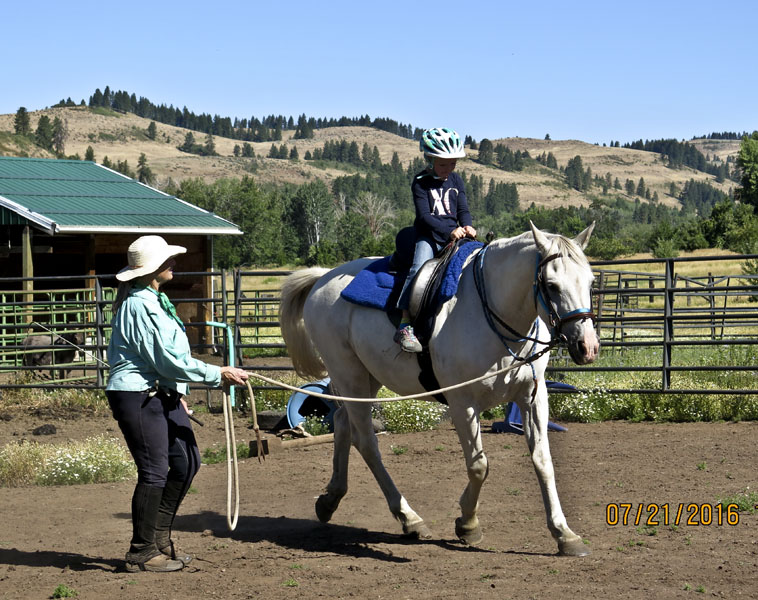
Grandma Dottie arranged for horse riding lessons for Quinn. Doesn't this look like "cowgirl country?"
On the day they were scheduled to fly back to Hong Kong, Christa entered the Mile High Mile, a one-mile swim in cold Payette Lake. She got first in her age class.
Christa and her long time friend, Jenny Schoen.
Christa’s mother-in-law, Dottie, came from Boston and regaled everyone with a wonderful puppet show and hula lessons on Polynesian Luau Night. Our two weeks went way too fast and soon we were saying goodbye to everyone and driving back to Seattle. The only unfortunate thing was both of us picked up a worsening bronchitis that had especially me under the weather during most of our stay in McCall. We both ended up checking into Urgent Care once we arrived in Bellevue for diagnosis and treatment. It’s tough out here in the real world.

We were fortunate to house sit for old sailing friends Rod and Maryhelen Johnson who have a beautiful home in Trilogy at Redmond, about 10 miles northeast of Bellevue. It’s a planned community for over 55 year olds with more than 1,000 homes, a club house, pool, and golf course. It was a great experience for us to see how we might like living in a planned community and in the Redmond area in general. We figure we have about one more year on the boat and then we’ll put it up for sale in Australia. In the meanwhile we have to decide where in the US we want to live when we return. Not an easy task.

These three beautiful women, Marne, Patsy, and Meryl, all met when they were Pan Am flight attendants.
Our friends Patsy and Steve Larson hosted us and Bob & Marne McCluskey for dinner at their impeccable Bainbridge Island house.
We spent about three weeks at Trilogy, enjoying time with our grandkids, visiting with old friends, and ordering various supplies via Amazon before our return to Tahiti. Meryl had her 50th high school reunion towards the end of our stay and enjoyed seeing friends for the first time in many years. It seems there’s never enough time, and this year was more difficult since we were sick for the first few weeks and had to compress many activities into our last two weeks.

High school classmates Marilyn Lowry, Meryl, and Anita Snyder.
We went through our typical ritual of unpacking Amazon packages and then repacking everything into our two 50-pound grey duffel bags. We found we had some stuff left over and are hoping our friends Patsy and Steve will bring a duffel when they fly down to visit us at the end of the month. 

We then drove back to Boise to drop our daughter’s car off, prayed that TSA wouldn’t take all the weird stuff like boat wax out of our bags, and boarded the flight to Denver, then another flight to Los Angeles, and finally the 11:45 pm departure for Papeete. It’s funny to think about going back to Tahiti as “going home” but that’s what we talked about on the plane before falling into that weird “I’m so tired I’m going to pass out but really can’t sleep because I’m stuffed in an uncomfortable airline seat for seven hours.” 

And so it goes.

Sunday, June 26, 2016

The Pacific PuddleJump Rendezvous


The Pacific PuddleJump is an offshoot from the famous BaHa HaHa sailboat rally sponsored by San Francisco sailing magazine Latitude 38 that runs from San Diego to Cabo San Lucas every October. Not really a race, it’s more of a on-going party all the way down the Pacific Coast of Mexico. Hundreds of boats participate each year, with many returning home after the rally. For the others, also numbering in the low hundreds, some succumb to the easy life and cruise Mexico. Another group, who most would consider somewhat mentally unstable, think “wouldn’t it be fun to sail another 2,800 miles across the Pacific Ocean to Tahiti?” Ergo, the Pacific PuddleJump.  

“Jumpers” leave mostly from Cabo, Mazatlan, and Panama, each route presenting it’s share of joys and tribulations as you cross various weather zones on your way to Tahiti.

Flying Cloud should have “jumped” in 2013, but we decided to spend an additional season in the Caribbean. When we finally did cross in 2015 we ended up on a tighter schedule than anticipated and missed the big 2014 Tahiti/Moorea Sailing Rendezvous party in Papeete and Moorea. Determined not to make that mistake again we signed up for the 2016 Rendezvous, which is why we were now in Papeete.

Once again we were on a tight schedule (can you say “traveling with the Conners?”) and planned to fly to the US on July 1st. Our concern with participating in the actual Rendezvous sail from Papeete to Moorea was if the weather turned bad we wouldn’t be able to make our flight. Luckily we came up with the plan of leaving the boat at the Papeete City Marina, taking the ferry over to Moorea, and spending the night in an economic  hotel. Our luck got better when John and Deb Rogers invited us to crew on their 62-ft Sundeer sailboat called Moonshadow for the Papeete to Moorea passage. 

Andy Turpin from Latitude 38 was a great host for the cruisers. Here he MC's a presentation on "Cruising in French Polynesia."
We shared dinner with the intrepid crew of Huzzah, from left to right: Walter, Fred, Gerry, Jodie, Christine, Theresa, and Ken.

On June 24th (also my 69th birthday) we all attended the kick-off party for the Rendezvous in Papeete. Over 140 people showed up and we had a grand time with seminars, a cocktail party, and sultry Tahitian dancers.

The breathtaking harbor at Cook's Bay. The blue ship on the right is owned by the president of Samsonite Luggage.
The next morning we showed up at Moonshadow ready for the sail of our lives (this is a 62 ft. boat that can really scream in the right wind), but alas, not a breath of wind in sight. We ended up motor sailing most of the way to Moorea, still in the front of the fleet mind you, and finally catching some wind as we rounded the corner leading into Cook’s Bay. We throughly enjoyed the hospitality of John and Deb and dreamed of owning a boat like Moonshadow.

I really love the pulsating drum beats of Tahitian music.
These guys were incredible.
I also like watching the Tahitian women who can move their hips like no others.
Don't ask me how I got my picture taken with Miss Moorea and her court.
Once anchored in Cook’s Bay along with about 60 other Puddlejump boats, we dinghied ashore went to check into our hotel, but found that the clerk had locked all the room keys in the office, along with the only office key!  We finally got one room opened so we could shower and walked the mile to the location of the Puddlejump party, the well known Bali Hai Resort. It was great to see many of our friends there, including the crews of French Curve, Huzzah, Kandu, and others. We enjoyed another great evening of cocktails, Tahitian dancing, and dinner. Afterwards, Meryl and walked back to our hotel (with the Walter phenomenon of street lights turning off was we walked under them the whole way) only to find the fortress-like hotel locked up tighter than an drum. Even the Huns couldn’t have scaled those walls. Only after making complete fools our ourselves by yelling, screaming, and whistling did someone come and let us in. We were not happy campers.

We are ready on the start line in Cook's Bay for the starting gun to go off.
I'm sure we thought we were King of the Mountain with that strong finish, but we were soon humbled in Heat 2.
The Winners (kind of). Cheryl won't give up, she's still paddling us in.
Walter, Cheryl, Meryl, and Mark.
The next morning the owners of the hotel treated us to a nice American breakfast to say sorry and we walked back down to the Bali Hai for the day’s festivities. The highlight of the day was the Tahitian 6-man canoe races. We teamed up with the Mark and Cheryl from French Curve and named our team The Winners (a little premature on that one). We got some paddling lessons from ace canoer Eric on Kandu and practiced on our way out to the start line. We raced against four other canoes and were in the lead rounding the first mark (by the way, it’s not easy turning a 40 ft. outrigger canoe). Thanks to a couple of young Tahitian ringers in the bow and stern (and a very fast canoe) we took first place in our heat. Not too bad for a bunch of old farts.  We forgot how competitive most sailors are and were amazed watching the other heats how much effort everyone was putting into the racing. A little cocky from our earlier success, we got our clocks cleaned in the second heat barely eking out a third place. I think Mark and I both tried to “muscle it” too much rather than paddling in smooth synchronization. Anyway, we had a great time and cheered on the canoes in the final heat.

Just like after a sailboat race, back on shore we nursed our drinks and talked about how we could have won is we just did …. It was great fun and a memory we will cherish for a long time.  Soon the Tahitian “Games” began, things like running around a course carrying a palm tree log, lifting an 80 lb. rock to your chest, coconut husking, etc. There was also a great demonstration of 50 ways to tie a pareu. The Tahitian host, a huge mountain of a man, was a great MC. His best quote of the night was “We used to eat white people when they came here, now we don’t. Too much cholesterol.”

Exhausted after a big weekend, we ride the fast ferry back to Papeete.

At the end of the day we caught a cab back to the south side of Moorea and boarded the modern catamaran ferry that runs back to Papeete. Sitting in airplane-type seats we didn’t understand why there were hostesses handing out small white plastic bags. Once the ferry left the dock we ran into some huge rollers coming from the ocean with the boat rolling up and down and from side to side. Now we know what the bags were for.

Tuesday, June 21, 2016

Back to Papeete

With time drawing short for our arrival in Papeete, we left Tapuamu Bay early on June 15th for the130 mile overnight passage to Moorea, our stop over on the way to Tahiti.  We knew it was going to be a bumpy ride given the high seas churned up by last week’s storm and we weren’t disappointed. We had hoped for a little more easterly component in the wind, which always magically seemed to be right on our nose. We motored out the pass Teavapiti Pass on Raiatea and sailed close hauled for the tip of Huahine, even though it was about 30 degrees off our intended course to Moorea. Around 5:00 pm we threw in the towel and started the motor, turning on a more southeasterly rhumb line course for Openua Bay on Moorea. Motoring into stout seas seems to be our forte lately, and while not terribly bad it was still an uncomfortable night. 

This graphic from our MaxSea Navigation software shows Flying Cloud (large red image) surrounded by ships at 2:00 am.
We set an alarm for every 20 minutes to remind ourselves to scan the horizon and check the AIS for any ships in the area. During my watch the AIS lit up like a video game with activity, including the 504 ft. cruise ship Paul Gauguin and three inter island freighters. Somewhere out there was another sailing vessel but I never saw him on radar. I called the Paul Gauguin to make sure they saw me even though I was about 10 miles dead ahead. The very courteous captain replied that he saw me on AIS and mentioned he was just killing time on his passage to Moorea as he didn’t want to arrive in the dark given the narrow pass into Opunohu Bay. 

To help pass the time on night watch I have been listening to the audiobook Nobody’s Fool by Richard Russo, but over the last five months I never seem to finish it. I probably hold the record for the longest time to complete an audio book (and trying to remember the characters and plot line of the book).

A 130 ft. custom Wally yacht dominates the anchorage at Opunohu Bay. The speed boat in the foreground is their "dingy."
This iconic Pan Am poster has been the impetus fro many a sailor to head to Tahiti.
Around sunrise we could make out the towering mountains of Moorea and enjoyed breakfast in the cockpit as the mountains grew closer and closer. The peak behind Opunohu Bay is famous for having appeared on the iconic Fly to the South Seas Isles poster with the Pan Am flying boats. Just after clearing the pass we turned left to a small anchoring area between the shore and the reef. Our singlehanded friend Franklin was patiently waiting for us and soon came over with the Honda genset we had loaned him a month earlier. It was great to see him and he was very appreciative of our generosity, but that’s what you do when another cruiser is in need. 

Our Tacoma friends on Huzzah showed up the next day. Their wives had recently arrived in Papeete and were anxious to see the outer islands. After three months of “just the guys” on the boat we could tell they were very happy to be able to show off the South Pacific to their wives.

We had hoped to dingy over to the Intercontinental Hotel to visit “Stingray City,” a place off the hotel where guides feed the fish resulting in stingrays and black tip sharks swimming close to the tourists. Unfortunately a persistent 23- to 30-knot wind was wapping around the north end of the island and screaming right down the line of anchored boats.  We did manage to get ashore and doing some walking, including a short walk up to the Hilton Hotel for some $5 Cokes on the beach. 

Since our goal was to get to Papeete for the start of the big Pacific PuddleJump Rendezvous on Friday the 24th, we decided we’d better get going if we hoped to score a spot in the marina.  Naturally we were a day too early weatherwise and had an uncomfortable crossing with the omnipresent headwinds and 2.5 meter swells off our port bow.  When we arrived in the harbor in Papeete in a blinding 30-knot squall we could see there were only a few slips left and we headed for one at the eastern end of the marina. Even though it was still blowing 17 knots when we arrived we managed to snuggle up to a windward finger pier thanks to the help of a petite blonde on the boat next to us who was from Seattle, of all places.

I looked for months for a can of this excellent varnish, finally finding it at the Ace Hardware store in Papeete.
The next few days were spent walking around town, taking our old anchor windlass motor in for repair, scoring some of the great V33 Bateau Varnish that I love, and beginning to wet sand our cap rail for it’s semi annual coat of varnish. Oh, and getting chocolate sundaes at the local McDonalds.

John and Deb Rogers who own the beautiful 62 ft. Sundeer, Moonsha
Walking around the back streets of Papeete we ran into John and Debbie Rogers off the 62 ft. Sundeer called Moonshadow. We’d last seen them in Portsmouth, Virginia in 2012 and had followed their blog ever since. We ended up sharing a bottle of wine at the Retro Restaurant and then going over to the “roulettes” food trucks for dinner in the light rain. It was great to get caught up with them and hear about all their adventures for the last five years.


The next couple days leading up to the big PPJ Rendezvous were spent finishing the varnishing, exploring the back streets of Papeete, and finally getting the stamps in our Carte de Secour, our French visa that allows us to stay in French Polynesia for one more year.

Monday, June 13, 2016

Pearls 'R Us

The stormy weather finally subsided on Monday, June 13th and suffering from cabin fever being on the boat so long, we decided to go for a bike ride. A highly energetic Tahitian woman rents out great “cruiser bikes” for $20/day near the gas station and dingy docks in Tapuamu Bay. With steer-horn handle bars, big cushy seats, and a single gear we set off north from Tapuamu Bay (which we learned means “cut and bait” to the local fisherman). 

I think the last time I road a bike like this I was 12 years old.
The road follows along the shore and is perfectly flat so the riding was easy, although we hadn’t biked on one-speed bikes in years so our muscles were getting a work out. The scenery from island to island is fairly typical:  small concrete block houses with dense foliage, chickens running across the roads, people on scooters, and locals in Japanese pick-up trucks. Most everywhere people wave and say l’orana (hello). Whenever we stop people seem to come over to say hello and offer us pamplemousse and other fruits.

The views over the water were, as always, spectacular with the calm azure blue waters of the lagoon contrasting with the big waves breaking over the fringing reef. We soon realized we weren’t in good enough shape to make it the 40 miles around the island so we settled on just pedaling up to the small town of Patio and getting lunch from the local supermarket. We sat on a bench along the water, and realizing our ham baguette sandwiches were also full of french fries (the French love their french fries), we ended up feeding the local dogs with bits of this and that.

I explained to the host about what it was like to work in a windowless room staring at a computer screen. He said "My workplace is a little more scenic."
On the ride back we decided to stop at a pearl farm we’d seen along the waterfront. Called the Love Here Pearl Farm, it is run by a local family and turned out to be highly interesting. A women and her very handsome son patiently explained the pearl farming process and educated us to why cultured pearls are so expensive given all the work it takes to culture and harvest them.

Compared to the beautiful jewels they produce, actual pearl shells are kind of ugly. 
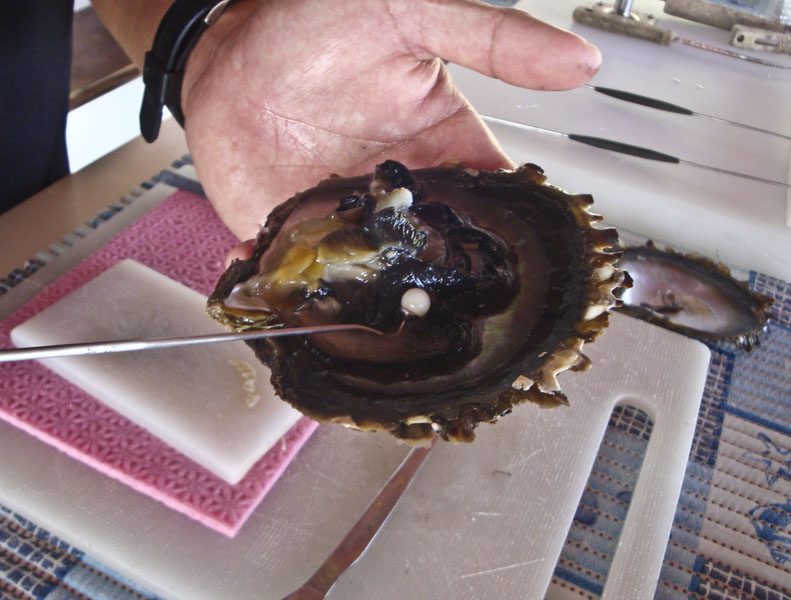
It takes surgical precision to open the live pearl shell just 2 to 3 centimeters and insert the mantle and nucleus pieces.
Here a piece of mantel is removed from a donor shell and the black portion is scraped off.
The mantle piece is then inserted against the gonad and the nucleus bead is placed against that. This is normally done with the shell only open 2 - 3 centimeters.
Essentially the pearls are artificially inseminated by taking a tiny piece of mantle from a donor pearl and placing it into the shell in a special location (by the gonad, the reproductive organ of a pearl). Against this is placed a pea-sized nucleus bead made made from a very specific type of mussel shell grown only in the Mississippi River. The pearls only allow themselves to be pried open about 2 - 3 centimeters so placing the mantle piece and nucleus bead takes time and surgical precision. 

The inseminated shells are then placed in mesh frames and hung in deep water for up to a year.
The pearls are then placed inside mesh net frames and hung from buoys in up to 80 foot of water inside the lagoon where the oyster secretes layers of nacre, the shiny substance that gives pearls their unique luster.
The hosts explain how they select and grade the pearls. 
Pearls are graded on size, shapes, lustre, color, and quality (imperfections)
I didn't bother to ask what this little puppy sold for.
One of the most popular purchases in the stores are the single pearl necklaces.
The pearls come in every imaginable shape, size, color, and price.
During the six month maturation process divers go out and clean the mesh nets of seaweed, barnacles, and other pollutants and check on the progress of the pearls. 

According to RawPearls.com:  

“Of the millions of oysters nucleated every year, only a tiny fraction of them produce high grade pearls. On average, about half of the nucleated oysters do not even survive to bear pearls. Less than five percent of the survivors yield pearls of the ideal shape, lustre, and colour to be considered fine quality. The few pearls that make the cut are then cleaned, soaked and sorted.”
As you might image, black pearls from the South Pacific are very expensive, even when you are here where they are grown. The best prices are found in the Tuamotus and Gambier atolls, home to a myriad of pearl farms. The problem is you typically have to go from house to house finding out which workers have secreted away some select samples during their work, as the actual pearl farms are prohibited from selling them direct to the public.


We had purchased a beautiful set of colored-hue black pearls for our daughter, but when we went back to the same store in Papeete to get some for Meryl the prices had skyrocketed, or maybe we just got a great deal on the first set. Anyways, we are still looking for that perfect strand for Meryl.

Wednesday, June 8, 2016

It's Not Supposed to be Stormy in Paradise

We reluctantly departed “Paradise of Huahine” and motor sailed five hours west to the island of Raiatea. The pass entrance was easy but the approach to the town of Uturoa was a problem. The 20-knot easterly wind was blowing directly into the harbor making docking a little tricky. The dock that had been recommended had huge signs saying “3 Hours Only” so we tied to the northern end of the gas dock in front of a big charter cat. The wind was blowing sideways to the dock so we were somewhat pinned in place. 

We did a short walk around town and realized lots of tourists visit this village judged by the number of t-shirt and curio shops. There was a good Champion grocery store where we stocked up on a number of things, including a rotisserie chicken for dinner.  Just as it was getting dark a cruiser from Canada walked by mentioning to Meryl that this “city dock” was easily accessible to everyone and had high theft potential. He suggested tying to the dock we had first considered, but just getting over there and getting tied up in the wind and darkness was more hassle than it was worth since we’d simply have to come back here to get fuel in the morning. 

We ended up taking everything not nailed down off the decks, including our 10 ft. stand-up paddle board. Since some boats had even been entered at night, we had our defensive measures deployed. Luckily it was such a stormy night no one came down to the dock leaving us somewhat sleepless but greatly relieved.

It was still very windy the next morning so I had Meryl slowly motor the boat parallel to the dock while I fended off to get up to where the gas station was located.  The cruiser blogs have many mentions that the gas station owner is not very cruiser friendly, but luckily he wasn’t there and we topped off with 55 gallons of diesel at the tax free price of $2.36 a gallon, a steal in this part of the world.  With the help of a couple of big Tahitians we pushed the boat off the dock and motored around the north side of Raiatea toward the west side where the boatyard is located. 

As seems to be the case lately, the boat just ahead of us got the last mooring buoy so we searched for a suitable place to anchor, but could only come up with a 60 ft. deep patch where we let out most of our anchor chain.

Since it was Friday and the French are notorious for taking off early, we hurried into the yard to check it out as a place to leave our boat during the November to May cyclone season. It wasn’t a perfect solution, but we finally decided on storing the boat at the Raiatea Carenage (there is another yard here called CNI but it is more expensive). We will be taking a chance with cyclones but our insurance covers us here and it beats having to sail all the way to New Zealand and back. 

The highlight of our visit to yard was scoring some blue masking tape (that I use when varnishing) and two small BBQ propane bottles, all for the relatively cheap French Polynesian price of US $60 (which would be about $25 in the States).  I also found a can of the incredible V33 Marine Varnish so now we can get a couple coats on our cap rails.

Here we are anchored in a small pocket of water in between three coral shelves at Tupuamu Bay in Raiatea. We are anchored in 60 ft. of water and have all our chain -- 220 ft. -- draped along the bottom hoping it holds in the 25 to 30 knot winds.
On June 5th we motored north inside the reef to Moto Tautau, a place frequently mentioned in cruiser’s blogs for it’s great snorkeling. Just inside most of the reef system is a wide shelf of white coral/sand bottom about 5 to 10 ft. deep with numerous bommies.
These bungalows at the exclusive Le Taha'a Resort start out a about $700 a night, a little rich for our blood.
We anchored just off this large shelf in about 30 ft of water and took the dingy across the shallow part to a passage between Moto Tautau and the exclusive Le Taha’a Private Island & Spa ($700/night) with it’s 40 over-the-water bungalows. Imagine paying around $10,000 a week (airfare, room and food for two) for your dream vacation only to find high winds and torrential rain all week.

The coral heads are fairly close to the surface so when the current is running three plus knots you have to watch that your tummy doesn't rub on the coral.
When the current is running it's better to walk along the coral path on the northern moto and then float through on the tide.
The coral isn't that spectacular, but the number of friendly fish is amazing.
After the storm was over we went back with Baha and Nora from the Turkish yacht Tutkum for a great day of snorkeling.


Normally you anchor the dingy and walk along a path on the moto to the seaward end and simply drift with the current through the famous “Coral Gardens.” We elected to swim up current (only about 1.5 knots at that time) so we had more time to see the myriad of fish and get more exercise. The coral comes up just short of the surface so in places we had to suck up our tummies (me more than Meryl) just to glide over the coral. The number and variety of fish was amazing. We don’t have a Pacific fish ID book but we saw many fish we’d never seen before. Much of the coral is covered with a brownish plant, but in areas we saw bright white, azure blue, and ochre colored corals. Once we got to the seaward end (somewhat tired out from all the swimming) we turned around and slowly drifted back through the pass. We did this pass several days later (we had to walk along the path since the current was so strong) with about 3 knots of current and jetted along, having to bank our bodies to get over the shallower coral and then find a hand hold whenever we wanted to stop and look at fish. The fun thing was some fish just swam right alongside us, probably wondering who the heck we were.

A fairly substantial Mamaru (big southeastern storms in FP) was predicted to come through the next several days so we upped anchor (which was wrapped around a bommie and took some time to unwrap) and headed into nearby Tapuamu Bay. Again, the boat right ahead of us got the last buoy (huge bummer since this bay is very deep) so we spent the next hour motoring around trying to find a shallow enough spot to anchor. We found a spot surrounded on three sides by shallow coral, but the depth meters readings were all over the place so we weren’t positive how deep we finally dropped the anchor. When we pulled back on the anchor to set it I could feel it “skipping” on coral on the bottom and then finally holding, but I wasn’t sure if it was up against some coral or in the sand. It was too deep to dive so we essentially just worried about it for the next four nights. As predicted, the winds piped up to a steady 23 knots and gusting to over 30+ knots, which held true for next six days. We were not happy campers with the uncertainty of our anchor set, but it did hold us securely.

We have two other friends on mooring balls nearby, Wavelength and Ednbal, so that gave us some comfort if everything went loosey goosey, we had help nearby.  We had a potluck dinner on Wavelength (thanks Eileen) one night and sundowners on Flying Cloud another, but essentially everyone was just hunkered down for the storm working on boat projects or Internet for the duration.

In between breaks in the storm we walked along the shoreside road down to a small vanilla plantation and store.
While we look safely anchored, we are surrounded on three sides by a very shallow coral shelf, not a good thing when the wind is gusting to 30+ knots.
There is a great small inner harbor here with a gas station and grocery store with fresh baguettes, plus an easy tie up for the dinghies. We went for several walks along the shore road, including one lovely 3-mile loop through a vanilla growing area. We found a small curio shop just past the gas station run by one of the most outgoing Tahitian women I’ve ever met. She had several toere’s (pronounced “toe-eddie”) and I had been looking for one for sometime. It’s a special Tahitian drumming instrument made out of Pacific rosewood — essentially a hollowed out box with a central slit along one long side.  You hit it with a ironwood stick to produce that high pitched “tick tick tick” sound you hear with fast Tahitian dancing. 

These netted covers protect the fragile vanilla plants from the searing tropical sun.
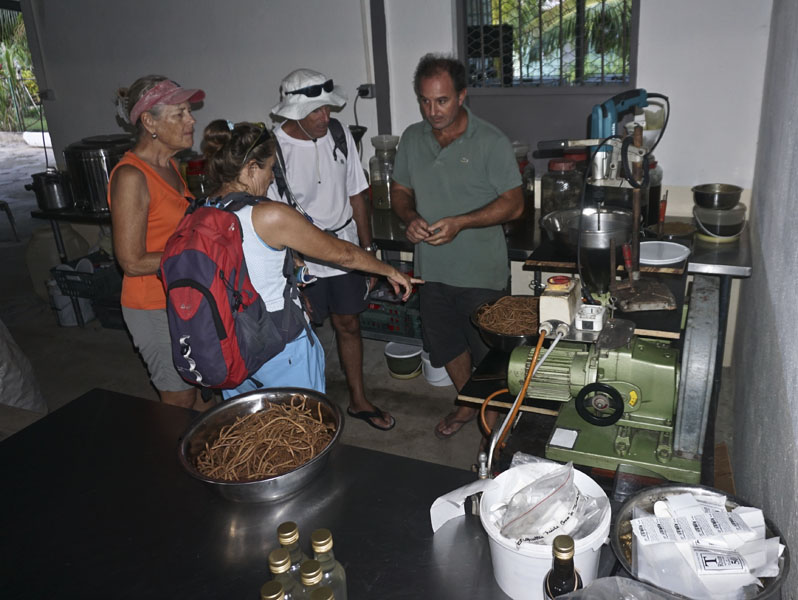
The owner of the Pari Pari facility shows us and the crew of Ednabal how a cold press extracts the oil from the coconut meat. They try to feed the curlycue remains to the goats, but even they find it too bitter. 
Producing the vanilla beans is a very time consuming process, which explains the high price of vanilla ($55 for the small packs shown here).
Pari Pari also makes it own "rhum agricole" from cane sugar. This bottle of 80 proof (40% alcohol content) sells for about $35, a pretty good deal in these parts.
Further down the road we saw some netted agricultural areas and discovered they contained vanilla plants. Taha’a is well known for its vanilla farms and we stopped at a new business called Pari Pari that made rum agricole (from cane sugar, not molasses like most rums) and extracted oils from vanilla and some local nuts. The owner and his wife, both from Paris, gave us the grand tour and explained how laborious the vanilla pollination, harvesting, and drying process is, which accounts for the very high prices of vanilla ($ 50 for a small pack of about 10 beans). There are no bees in French Polynesia that can pollinate plants, so, as the owner explained in that French way, "we have to have humans help in the marriage process." It takes several months after the beans are pollinated, then a then a four-month drying period where the beans need to be kept out of the direct sunlight.

In between breaks in the storm we visit other boats. Here is Florida-based North Star with the peaks of famed Bora Bora in the background.
The storm looks like it’s winding down after six days, but it’s still very windy. One boat left their buoy so we hurriedly upped anchor (all 220 ft of it) and motored over to the buoy only to find the loop in the three-strand line worn through to only one strand. I got into the dingy, Meryl handed me my iPad with the Ashley Knots app, and I proceeded to tie a very secure Icicle Hitch on the body of the line and double cow-hitched an eye spliced mooring line through the worn buoy eye splice so the edges of the line took more of the load than just the apex of the loop. Seems to be holding fine in the gusts, but is certainly one of the stranger tie-ups we’ve done while  cruising. 

We will hang out until about Tuesday then slowly make our way back to Moorea and on to Papeete for the big Pacific Puddlejump Rendezvous party on June 23rd to June 25th. We missed it last year so will see a number of boats that crossed last year and this year as well.  Should be quite a party.

Monday, May 23, 2016

Back in the Water Again

While we did some snorkeling in the Marquesas, the visibility was somewhat limited making for some anxious moments when a hammerhead shark came straight up from the depths and scared the beejesus out of us.

In the Tuamotus we had a lot of inclement weather which limited the visibility in what is normally crystal-clear water. We did some snorkeling but the high winds kept us on the boat more than we’d have liked.

Now, finally in the Leeward Islands of the Society Group (Tahiti) we’re back to clear water, beautiful reefs, and calm weather very conducive to diving, snorkeling and paddle boarding.

Stand-up paddleboards (or in this case, sit-down paddleboards) are becoming very popular among cruising sailors.
A couple days ago we finally got our RedFin 10-foot 8-inch paddle board out of its case and blown-up on deck. We’re anchored on some sand flats about an 1/8 mile from the reef, so the water is very protected and almost as clear as a martini without the olive. The water is actually so clear it's like walking over an aquarium when you are on the SUP. Sort of like stand up snorkeling, you can see the bommies and follow the fish here and there. 
When I got out to the anchored yellow proa near the reef’s edge, I began to see bigger shapes underneath me; white-tipped and black-tipped sharks. They hang out there because a guy comes out with tourists and feeds them (no, he doesn’t feed them tourists). I'm not really that good on the paddle board compared to Meryl so I make a concerted effort to not fall off at that particular spot. The sharks looked hungry and they hadn't been fed yet that day.
The other thing we dug out from the depths of the bilges was the SCUBA gear we had bought in Bonaire. We’ve wanted to go diving ever since Bonaire but the opportunity never presented itself, so we arranged for a local dive company, run by a woman to do a couple of nearby dives.

Our first dive was on Monday, May 23rd at a location just north of Fare called Fa’a Miti. Since Meryl and I hadn't dove since Bonaire a year and one/half ago, there was a little learning curve. But once we got in the water it all came back. Lots of fish came swimming right up to us (they are used to being fed), along with a couple of curious small sharks. The only negative thing was I noticed my GoPro underwater camera case leaking, so I quickly gave it to the dive master who took it back up to the boat, so instead of gorgeous underwater photos for this post you’ll just have to use your imagination.

The dive began in about 35 feet in an expansive area of beautiful coral gardens, with corals reflecting every color of the rainbow. I had never seen the delicate baby blue corals so that was quite a treat. Our dive master had us take our gloves off and touch the delicate white anemones where Nemo lives amongst the tentacles. They were very sticky and I assume the small wrasses that hang out there use the anemones to clean their skin.

There was a bit of current so we drifted around a lot, but as we gradually descended along a coral wall down to 90 feet the current was much less. Every SCUBA diver seems to want to dive deep, but in reality you lose the yellow and red colors at that depth and everything is a muted blue so it is not as pretty as the shallower depths. 

As we ascended towards the end of the dive (we carry underwater computers that tell us how long we can stay at a certain depths without have to do decompression stops on the way back up) we came into an area with canyons carved in-between the coral reefs. It was so magical to slowly drift through the canyons, some so narrow you could touch both sides. While it was somewhat of a beginner dive, we thoroughly enjoyed ourselves.

On Wednesday the 25th the dive boat picked us up at Flying Cloud and took us to the nearby Avapehi Pass. They anchored right behind the big surf break so we got to watch the local surfers do their thing on a very tricky wave. We then got a description of what was to be the most challenging dive Meryl and I have attempted. The dive would involve descending in very turbulent water near the surf break and then traversing over to the mouth of the pass while descending to about 90 feet. The dive master wasn’t sure how strong the current would be, but recommended we hug the bottom and use hand holds on the coral to move forward if the current was running.

We slowly descended to about 30 feet in what is best described as a washing machine, given the huge surfing wave overhead. We got sloshed four feet to the right then four feet to the left with each passing wave. We then followed the edge of the reef down to about 50 ft. to get out of the waves and slowly came around the corner at 85 ft to the start of the pass. The current was running a fast 3 knots against us and we could still feel the surge of the waves. When a wave pushed us forward we would kick hard, then quickly grab a small hand hold on the bottom so when the current hit us we wouldn't be swept back into the mouth of the pass. 

Meanwhile about 15 grey sharks were cruising nearby, including one who did a drive-by at us. They were only 5- to 6-feet long, but still got our attention. We had to really focus because if you let go of a hand hold for a second you’d get swept away in the current. We hung on tightly along the top of a ridge and watched the sharks and larger fish (mostly jacks) swim by being careful not to turn our heads too far sideways or our mask or regulators might loosen or fly off.  We then headed sideways back to the the edge of the reef. That was kind of fun since the current helped us skip from one hand hold to the next. 

Eventually we got back to the coral reefs in about 30 ft of water and marveled at the variety and sheer number of fish. For us it was the most technical dive we’ve done yet, but it forced us to really focus and learn some new dive techniques. A great experience at age 68.

In the subsequent days we’ve done lots of SUP’ing (my legs were so tired after a circuit of the bay I had trouble standing) and snorkeling in the nearby waters. The abundant coral heads attract lots of fish so the snorkeling is always interesting.

We will head south along the reef in the next couple of days to some more remote snorkeling areas where we hope to see an even larger variety of fish. It’s so great to be able to jump in the crystal clear, 82-degree water everyday and snorkel or just swim around. We’ve been waiting for this type of opportunity for a long time and are loving it here.