Thursday, February 7, 2013

The Wind Gods Give-ith and Take-it Away-ith


Open water crossings can be exhilarating sailing with blue skies, following seas, and wisps of sea spray gently caressing the boat. It's like a day up skiing with a foot of fresh powder. We always hope for these types of days for our passages. In our case we needed to sail 70 miles south from the Abacos across a chunk of the Atlantic Ocean to the north end of Eleuthera Island. To do this we needed a "good weather window."

Each morning at 6:30 am we worship at the altar of the wind god, Chris Parker of Marine Weather Center. Chris' voice crackles across the SSB radio with prognostications of highs, lows, troughs, ridges and all sorts of metrological stuff I still don't understand even though I've read six books on the subject. Bottom line is Chris said it would be "brisk sailing" today with 20 knots out of the east with 2 to 4 ft. waves. For a stout bluewater boat like Flying Cloud this sounded doable with the wind essentially coming from the side of boat (beam reach). It wouldn't be comfortable, but doable.

As we prepared to leave the anchorage the wind began howling as a squall line passed by with strong winds and pelting rain (remember, however, this is warm rain). Knowing that squalls are short lived, I proceeded to get soaking wet bringing the anchor up and getting underway (Meryl had the common sense to put on her offshore rain gear).


With each day's sail there are special problems that need to be overcome. In our case we had to transit from the protected waters behind the islands to the Atlantic Ocean (windward) side through a small pass called North Point Cut. We chose this pass since it was the better of the several passes we had to choose from, with a somewhat wide opening and not too many hidden rocks and reefs. The problem was the outgoing tide was running into the southeasterly wind and setting up what is locally known as a "rage." Think of a lot of water trying to get through a very small opening combined with lots of wind from the opposite direction trying to get through the same opening at the same time. The incoming wind hits the outgoing waves and amplifies their height, creating the dreaded "square waves" that sailors hate. A boat can ride up and down on ocean-type swells like a cork bobbing in the water. Square waves, however, are so tightly spaced that the boat raises up from one wave only to get smashed immediately from the next wave, and so on.

Back to the pass. It never looks that bad when you approach a pass; it's only when you're fully committed that the waves rear their ugly heads and nail you. In our case we ran into 6 to 8 ft. standing waves that were spaced very close together. The bow of the boat would rise toward the sky then come crashing down on the backside of the wave as the next wave buried the deck under tons of water, all of which came surfing down the decks back to where Meryl and I were huddled behind the protective dodger. It's like being inside a washing machine with all your stuff crashing around. To make things worse, we'd just reinstalled the foredeck dorado vent (and upside down L-shaped air vent that funnels air through a special "waterproof" fitting to below decks). We learned the hard way that the dorados on the foredeck need to be either removed or plugged with Nerf balls. Since we didn't anticipate these types of waves we hadn't do any of these things. More about that later.

Not a happy camper, but a great helmsman.
Once clear of the larger waves at the entrance we fell off (turned the boat more downwind) only to find that the predicted easterly was a full-on southerly blowing 22 to 28 knots. Again, our boat is very solid and able to handle these types of sea conditions; it was more about whether two 65+ year olds were up to the challenge.

I had to go down below to deal with a lot of unsecured items crashing around (again, we had anticipated beam winds which would have been much easier on the boat) and lots of water that had entered through the dorado vents. Forgetting my old rule about being down below very long in heavy weather, I started to feel queasy (again, hadn't thought we need seasick meds this day) and was soon hugging the companionway ladder with my head hanging over into the cockpit viewing a somewhat digested version of my breakfast. I wanted to die, but unfortunately was not given the option. The combination of the seasickness and the cold wet clothes had me shivering and curled up in a ball on the saloon seat. I've never been seasick in my life so this was a new and humbling experience. Poor Meryl, who had the common sense to put on her foul weather gear before we departed, had no choice but to hand steer (the autopilot had gone on strike) through heavy seas and 28 knot gusts for three hours while I tried to recover. I don't think I've ever been so proud of her hanging in during those very tough conditions, especially with me down below and not able to help.

Luckily I began to rally and while still very weak I was able to spell Meryl for a couple hours while she got some much needed rest. We basically just hung on and somewhat got used to the craziness ("wow, it's only 22 knots now, it seems so calm"). Again the issue is not so much the wind but the constant train of large waves hitting you head on every 10 seconds or so. It's like riding a bucking bronco for 10 hours.

There's no way we can cook in those conditions so we subsisted on animal crackers and water all day. Having lost most of my breakfast earlier I gained a new appreciation for animal crackers as a three-course meal.


With the boat totally trashed down below, with stuff strewn everywhere imaginable, we reconciled ourselves to just making our destination in one piece. We were about three-quarters of the way to our destination and had to make a decision about which way we would round Royal Island to gain entrance to the hidden harbor on the other side. Our choices were to sail through a very narrow pass called Egg Island Cut, or head further to starboard and round the outer reefs of the island, which would add about two hours to our passage time. It was now about 4:30 pm and we were fighting daylight to make our destination before dark. We made a command decision to go for it, hoping the southerly winds wouldn't be piling up huge waves in the pass like when we exited North Point Cut. To add some challenge to the task we also had to navigate between an unseen underwater rock about 20 ft. to our left and a mini island 20 ft. to our right. Luckily the conditions, while still very windy, were not too bad and we made it through the cut in one piece (breathe a sign of relief). The waves were much smaller on the windward side of Royal Island so we got a little break as we threaded our way though one last narrow opening into the harbor.

We never felt so relieved to get the anchor down and collapse on the settee seats. Walking over piles of debris inside the boat we voted to have a quick dinner of tomato soup and toasted cheese sandwiches before we literally fell into our bunk and went fast asleep.

I made a mental note to never leave protected waters again without the boat being fully prepared and us fully clothed in offshore weather gear. Also made a note to call Chris Parker about his prediction of easterly winds.

Wednesday, February 6, 2013

Hope Town to Lynyard Cay and Little Harbor

Much as we loved Hope Town and the comforts of the marina (plus all the fun time spent varnishing) we are looking forward to being on our way once again. Flying Cloud is looking much better with a newly varnished cap rail on her starboard side (4 coats) and will be getting another 4 coats along the way, weather willing. Plans to get to the port side are in the making. See Walter's entry about "V-Day--Zen & The Art of Varnishing in Exotic Places."

As always, we continue to deal with a) the lack of storage space or b) the plethora of junk we've brought onto the boat. As we prepared for departure we decided to keep the kayaks (inflated) on our bow for easier access in the Bahamas. We normally store them deflated under the dingy on the bow. With our new davits for the dingy, we now have additional options with the kayaks and are hoping they will get more use. The collapsible bicycles are normally stored on the guest berth along with a sundry of other items that don't have a designated location.

We left Hope Town with the morning tide to maintain a 1- to 2-foot depth under the keel as we exited the narrow entrance to the harbor. The weather forecast called for a mild easterly of 10 knots and with only 19 miles to cover, we had all the time in the world. So with full sails we headed south and cruised at around 4 knots. We were as content as can be ... no heeling and little to no sail adjustments and no tight time constraints. Could not have had a more beautiful and relaxing day.

We anchored off Lynyard Cay with some other sailboats and soon a dingy stopped by with some friends we had met in Hope Town on the sailing vessel (s/v) October. They had plans to head to Little Harbor later that day, but we had decided to help break in our new outboard by motoring the longish distance to the harbor, getting thoroughly soaked by the waves in the process.

Little Harbor has an interesting history. It was founded by the Johnston family as an art colony back in the 1950's. They actually lived like Robinson Crusoe in a cave until they built some structures including a foundry where they cast bronze sculptures from wax.

The original studio of Pete's father.
Today, the gallery is run by son Pete, who creates life size marine bronzes and runs the famous "Pete's Pub" restaurant. We loved the gallery and were tempted to purchase some bronze turtle sculptures but would probably have to store them under the dingy with the kayaks or put them on the guest berth with the bikes.


Down at "Pete's Pub" Walter and I had a local brew and enjoyed the eclectic scenery, which included hundreds of sailing t-shirts hanging from everywhere imaginable.

Tradition has it that each yacht leaves a t-shirt at the pub.
Pete's Pub is the perfect place to just lie back and relax.

Later, as we headed back to Lynyard Cay, we were very thankful that we had brought along our waterproof jackets to attempt keeping dry from the waves. Should have done it naked as we were soaked by the time we reached the boat.

Tuesday, January 29, 2013

V-Day


A $100 worth of varnish peeling off.
Today was the dreaded V-Day, the day we've long put off to start varnishing the teak on Flying Cloud. When we bought the boat it had sat unattended for some period of time and the varnish was beginning to fail on the exterior cap rails (the top trim piece that goes around the top of the deck all around the boat) and companionway hatch boards. Ironically, Taswell sailboats are renowned for their incredible teak, especially their all-teak interiors. Taswell's have gorgeous light colored teak interiors that are the equal to those on luxury yachts. It seemed like we owed the boat some work to keep up its pedigree. 

Now that we were ready, the weather wasn't. For the last several days it's been blowing about 25 knots out of the east, which means that our companionway is essentially the opening to a wind tunnel. I like a little ventilation as well as the next guy, but this has been ridiculous. Boeing could test airplane models inside our boat. So V-Day had to be put off for several days.


Today's gentle breeze, however, meant we could wait no longer. We dug out all the varnishing paraphernalia from its storage location deep in the bowels of the boat: heat gun, scrapers, scraper sharpeners, sandpapers of various grits, sandpaper holders, varnish, turpentine, brushes, stir sticks, tack racks, foam brushes, and so on. Two plastic boxes full of just varnish stuff.

 We began by first taking photos of all the locks, hinges, latches, etc. that would have to be removed from the companionway doors. It seems we can never remember what goes where when the varnishing is completed. We then labeled everything so we'd have at least a sporting chance of getting it back together.

The next step is removing the 8 to 10 coats of varnish on the cap rails. To do this we use a Milwaukee heat gun, one of those tools craftsmen speak of with quiet reverence. It essentially puts out enough heat (1200 degrees) to melt some metals. You carefully aim the nozzle towards the varnish you want to remove and try (try is the key word here) to avoid the varnish you don't want to remove, or plastics or other flammables. If you are smart, you will have taped off all the important areas to be protected, but hey, we're professionals here and don't need no stinking masking tape. Then you slowly apply nuclear heat to the varnish until it begins to bubble (but not enough to burn the wood .... the time difference between these two states is measured in microseconds).

What are the odds that either the heat gun or scrapper will fall in the water?
Slowly you move your scraper along the softened varnish (Did I mention I'm leaning over the side of the boat which is rocking back and forth from the wakes of passing boats?) which hopefully peels up Goldilocks-type curls of old varnish. Of course if it doesn't you apply more brute force to the scraper, which then either slips and slices your wrist open, 2) gouges the fiberglass next to the wood, or 3) slices across the grain of the wood like some slasher from a horror movie. Normally these long curls of former varnish fall to the floor, unless of course the wind picks up in which case they all blow into the cabin where the wife is sitting and beginning to get pissed-off.

We also had to take of 88 ft. of stainless steel rub rail with 176 screws.
Once all the varnish is removed, you get to crank up your second favorite tool, the fabled Porter-Cable SpeedBloc sander, with enough RPMs to have a gyroscopic effect when it starts. This power sander is the sander all other sanders want to be when they grow up -- a beautifully engineered piece of machinery. With those 15,000 RPMs comes one downside, lots and lots of dust. Normally I like teak dust but the wife doesn't share my eclectic tastes. Now imagine a 10-knot breeze kicking up and blowing all this teak dust into the saloon where she's sitting working on her computer (and still pissed off from all the Goldilocks curls that blew in earlier). Well, we don't have to go there, but you get the idea (this eventually resolves into lots of dirty looks and a three-hour extended shopping trip for therapeutic purposes). With the boat now totally covered in dust it's now time to bring out Mr. Vacuum and try to suck up all the strata layers everywhere before wife gets back from shopping trip. Stay tuned tomorrow for tips on how to spill varnish all over the boat.

Thursday, January 24, 2013

The 6 of Diamonds


It all started quite innocently, a great day at the beach, a fabulous lunch at Sea Spray, and Meryl's delicious tacos on the boat. Then, sitting around the saloon table nursing a drink, someone mentions a game of cards. But we need to regress a little before going forward. Over a period of about 20 years we have enjoyed an annual camping trip in the Washington Cascade Mountains with our friends Patsy and Steve Larson and Scott and Georgia McRae. Patsy was the one who introduced us to an innocent card game called "Screw Your Buddy" (there are other derivations of the name). If you knew Patsy, you would be shocked she would even say the word "screw" in mixed company. The game starts innocently enough with four cards being dealt to each player, with a card turned over from the deck to start play. The goal is to rid yourself of all cards by laying down a card matching the suit or number of the exposed card during your turn.

Sounds simple enough. You see a 10 of Hearts and you either lay down a Heart or a 10. If you are like me and fancy yourself a good card player, you feel you can easily master this simple little game -- I mean it's not exactly Contract Bridge. There are a few little quirks to the game that make it interesting. If someone before you plays a 2 or a 4, you have to pick up 2 or 4 cards. This usually happens when you are only one card from winning the game. Can be very frustrating.

Since Patsy is the keeper of the rules and we play the game infrequently, she receives occasional emails from me to refresh myself of the protocols. It seems with each email I receive, there is "one more rule I forgot to mention" which completely changes the outcome of the game. Such it was last year when we learned if someone puts down a 4 ahead of you, and you have the 5 in the same suit, then that person has to pick up 5 cards instead of you picking up 4 cards. Could be devastating if you had only a few cards left and thought you were on the way to winning. This year's email added another twist, if the person before you plays the 5 against your 4, and you have the 6 in the same suit, they have to pick up six cards. Super devastating. So back to our game. I generally make it a practice never to play with people who used to have summer cabins where they sat and played card games while on vacation. Now I don't know if that was the case with our friend Irene, but I had my suspicions. She had "the look." We had decided to introduce Paul and Irene to a friendly game of "Screw Your Buddy." It took a few rounds for them to understand the rules and strategy and for us to remember all the permutations of the rules, but they seemed to pick it up quickly. None the less, I was confidently (some might say smugly) leading in points (meaning I had less points ... and you play to 500) during the first several rounds.

Then (as the sailors say), the tide began to turn. Irene, who was seated "upstream" of me, seemed to be getting the concept of giving me 2's and 4's. Again, with a comfortable lead and years of experience playing the game, I preserved and managed to eke out only 10 to 20 points per hand. Then on the next hand, with only a single card separating me from certain victory, Irene lays down the dreaded 4 and I (with that smug look on my face) whipped out the 5 accompanied by some sort of trash-talking comment hoping to put an end to her aggressive play. It had its intended effect.

With the game continuing and my lead holding, I regained my confidence and assured myself that victory was only a few hands away. I was once again on the cusp of victory when Irene again let the 4 of Diamonds slowly drop from her hand. With some sort of derogatory remark, I quickly threw down the 5 of Diamonds to finally put her in her place. Without losing a beat, she slammed down the 6 of Diamonds and watched as I went into apoplectic shock. It is rare for a 5 to be played in response to a 4. I've only seen one during a whole night's play. It's very rare for two 5's to be played during a game. And it's unheard of for a 6 to be played in response to a 5, yet there it was. Rather then trash talk me back, Irene sprang from the table and began a credible version of the "Funky Chicken" to bring her point home. It was all downhill from there. As my scores quickly deteriorated, Paul simply declined to read out the scores in deference to me. Let's just say I got to 500 very quickly that night.

As I said, don't play cards with guys named Lucky or women who may have stayed in a summer cabin with her card-playing family while on vacation.

Tuesday, January 22, 2013

Exploring Hope Town


Vernon, the king of quotes.
We spent the morning snorkeling in some fairly calm water on the east side of Elbow Cay in the Atlantic Ocean. The beaches sloped steeply uphill, reminders of Hurricane Sandy, but still a beautiful beach with water just the right temperature and some nice coral reefs to view. Following our snorkel we took a little rest and enjoyed the sunshine on the beach. For Paul and Irene, coming from Seattle with typical Jan 30-40 degree rain/snow it was like heaven.

We decided to tour the town and bee-lined it for the best local homemade ice cream shop, "Sugar Shack", of course, just in time for lunch and well worth it! We also visited one of the local grocery stores, Vernon's and picked up some delicious fresh baked bread.

Vernon is a local legend in Hope Town with hundreds of quotes and witticism's posted throughout the store. Many locals are lifetime inhabitants with relatives dating back to 1785, when the Loyalists founded the island. Vernon promises us fresh coconut bread and key lime pie tomorrow.

Those are Vernon's quotes hanging from the top of the rack.
During our visit last year, we had stayed on a mooring ball for a couple nights, which is a nice compromise between anchoring and staying at a dock. You still have your own space with the nice breezes to keep your boat comfortable. This year we decided to stay at the Hope Town Inn and Marina for a number of reasons; convenience for guests, power and water for our upcoming varnishing project, great off-season pricing with our Royal Marsh Harbor Yacht Club membership, and a newly renovated facility with a terrific pool and restaurant-bar. We spent part of the afternoon with our books and drinks by the pool. Having Paul & Irene visit us meant we could take a little mini vacation as we don't always take breaks from the demands of a cruising life-style.

A beautiful woman finally gets some time to relax.
Later that afternoon, we walked over to the Hope Town Lighthouse, which is still in used in a traditional way, using a small kerosene-fueled mantle and a huge rotating glass Fresnel lens to send a beam of light as far as 20 miles. The lighthouse requires the hauling of 5-gallon drums of kerosene with a pulley system up the open stairway to keep the light operating.


We climbed to the top and took in the view and marveled at how they still maintained the lighthouse with technology from the 1860's. It is said Hope Town was once very prosperous from shipwrecks off the island salvaging the cargo and usable parts of ships. Some local residents tried to protect their livelihoods by sabotaging the construction of the lighthouse.

Sunday, January 20, 2013

Welcome to Paradise


We love having guests join us on Flying Cloud, but getting ready for their arrival is usually a major fire drill. You make many concessions when living on a boat, the biggest of which is living in the space of a large closet. Since the Conner's genetically travel light, we have the entire menagerie of books, tools, snorkeling gear, fishing poles, grill for the BBQ, suitcases, canvas boat bags, bikes and kayaks. Most of this lives in the guest berth, which we fondly refer to as "the garage." It is piled high with junk; so much so that we have to tie everything down when we go offshore least we have a major junk avalanche at sea.

Since many of our guests would take umbrage at sharing their berth with a bicycle or kayak, all of this stuff needs to find a home somewhere else prior to the guests' arrival. So for the last few days we've been frantically searching out new locations for all our stuff. The suitcases go at the foot of our bed, the kayaks go on the foredeck, the bikes behind the granny bars at the base of the mast, and everything else gets stuffed -- and I do mean stuffed -- into the forward storage locker. When we're finally done stowing everything, I marvel at the uncluttered guest berth and smile as Meryl fluffs the pillows and puts a nice note and a piece of chocolate on the bed.

Now soaked in sweat, we take a quick shower and rush to catch the 3:00 pm ferry boat from Hope Town to Marsh Harbor, about six miles across the channel. Luckily there is a taxi waiting so we jump in and urge the driver (Paulette) to make haste to the airport since we're now running late. Paulette shows little concern and coyly points out the airplane circling overhead as we approach the airport. I forgot that small town airports are like that.

We jump out of the cab just as the plane taxis up and prepare for an hour-long wait as our friends clear Bahamian Customs. Trying to compose ourselves we peek into the customs hall (the size of a small living room) only to see our former neighbors, and long time friends Paul and Irene Ballew walk through the door. We quickly assume our "laid back in Paradise pose" and welcome them to the Abacos. For someone from Seattle I'm sure they are just happy it isn't raining.

Paul and Irene land in Paradise.
Paulette is still waiting so we pile into the cab, exchange a years worth of news, and amazingly make it back to catch the 4:00 pm ferry to Hope Town. While they have traveled extensively, Paul and Irene are swivel-necked as the ferry passes by drop-dead waterfront homes and picturesque islands and reefs.

Hope Town Inn and Marina.
The entrance to Hope Town is especially interesting as the channel narrows down to almost nothing and then does a dog leg right and left to enter the hidden harbor, once a favorite haunt for pirates. The ferry drops us off at the Hope Town Inn and Marina and rather than rush down to the boat we stop at the beautiful outdoor bar/pool to have a drink and relax.

Outdoor lunch in Hope Town is radically different than an outdoor lunch in Seattle in January.
Thanks to our orders of a locally invented drink, the Goombay Smash (1 oz. dark rum, 1 oz. coconut rum, 1/4 oz. apricot brandy, 2 oz. pineapple juice, and 2 oz. orange juice . . . and remember, rum is cheaper hear than water), we are feeling no pain, or our tongues for that matter, after a few drinks. To acclimate them we also order an appetizer of conch fritters, a first time food treat for the Ballews (tastes just like chicken).

After a short walk down to the dock we introduced them to their new closet, err guest berth, for the next week. A tradition when guests arrive on a cruising sailboat is the giving of gifts, in this case six fan belts for the engine and genset, one Balmar electronic regulator, six cruising guides to the Windward/Leeward islands, and three large cans of WSU Cougar Gold cheese. Now Paul knows why I urged him to "pack light and leave a little extra room in your bag." It's not true that cruisers refer to arriving guests as "my parts delivery service."

Meryl prepared a great mixed salad and Paul and I experimented with blowing ourselves up as we tried to keep the BBQ lit in the 10-knot wind while cooking steaks. After a great dinner in the cockpit (the temp actually dropped down to 75 degrees) we retired to the saloon to get caught up on our lives, careers, kids, and especially, grand kids.

What a great evening with great friends.

Monday, June 6, 2011

The Boat

Flying Cloud, 1999 Taswell center-cockpit cutter rigged sailboat.
Flying Cloud is a 1999 Taswell 44 center-cockpit cruiser that is rigged as a cutter. Choosing a name for the boat was difficult, but we liked something that tied Meryl's flying career with Pan Am to sailing. All the Pan Am jets were named after clipper ships, so we researched the history of the clipper ships, finally settling on Flying Cloud, an airplane Meryl flew on at one time. This clipper ship set the sailing record in 1851 from New York via Cape Horn to San Francisco (89 days, 21 hours), a record that was not broken until 1989. More amazing, this was the vessel's maiden voyage and she was navigated by a woman, something almost unheard of in those days. See details at http://www.cupexperience.com/flying-cloud/


As a center cockpit model, the boat features a spacious aft owner's stateroom and a forward double guest berth. All Taswells are semi-custom built and vary in their interior layout and design. According to the original owner, the 44 ft. model was conceived as an up-market version of the popular Taswell 43. It is believed that only four Taswell 44's were constructed, with Flying Cloud being Hull #1 of the series. The boat was purchased by Frank Wohlford of Bainbridge Island, WA and built at the Ta Shing Shipyard in Taiwan. Frank supervised the construction and added many custom features to the boat, which he named Carolina. It was sold in 2009 to an owner in Fort Lauderdale and renamed Sara. We purchased the boat in Fort Lauderdale in May 2011and had it trailered to St. Petersburg, FL for six-month refit. Flying Cloud was launched on January 2012.  

The Design

Ta Shing Yacht Builders located in Tainan, Taiwan.
Designed by England's Bill Dixon and built at the Ta Shing Shipyards (http://www.tashingyachts.com.tw/), the yacht represents the epitome of craftsmanship and quality construction. Ta Shing, builders of the renowned Nordhaven motor yachts, were rated by Steve D'Antonio as one of the world's top shipyards in a recent article. Ta Shing is famous for its teak cabinetry, trim, and decks; it is one of the few yards in the world that imports it's own teak trees and mills the lumber at the factory.

Production line at Ta Shing factory.
The boat is very similar in quality, design and construction to the Hallberg-Rassy 43 constructed in Sweden. It is a rock solid offshore design with a semi full keel, skeg hung rudder, mid-cockpit design with a cutter rig.

Cockpit of Flying Cloud while under construction.

Construction


The hull is completely hand laminated as a one-piece fiberglass molding with six full-length foam-filled stringers, two heavy laminated longitudinal floor and five heavy laminated transverse floors. The gelcoat is isopthalic type that offers the best water and chemical resistance. The deck is cored with a high strength end-grain light wood while the more vertical surfaces are cored with end-grain balsa for light weight and "print" resistance (when the gelcoat "shows" the grain of the underlying fiberglass). The deck-to-hull joint is specially reinforced and installed on a layer of 3M 5200 for highest strength and water-tightness. It is screwed together with 5 mm stainless steel self-tapping screws on 6" centers. The teak cap rail is then installed and the entire joint is bolted together with 5/16" ss bolts on 6" centers.

Interior Spaces 

The extremely high level of workmanship and the extensive use of teak in the interior is unmatched in most modern yachts today. 
Custom made teak salon table.
Each Taswell seems to have a different interior layout, with some having the traditional design with the galley on the starboard side and others have a lengthwise galley in the passage between the saloon and the aft stateroom. Like everything on a boat, each design offers advantages and disadvantages. While our galley space is more limited, it provides a very safe place to cook while underway with plenty of handholds and places to brace your hips when the boat rolls. Everything is within reach and the design is very space efficient.
  

The Salon

Saloon and galley looking aft. Passageway on right side of photo leads to aft cabin.
Taswells are renowned for their golden teak interiors with precisely fitted cabinets and trim. The entire interior teak package is actually spray varnished in place, which provides a piano-like finish rarely seen in all but the most expensive yachts. The spacious saloon area has a custom teak table on the port side and a settee area on the right, with storage under all the seating areas. The boat features a cream-colored Majilte headliner in all cabins with overhead insulation, along with LED recessed overhead lighting that gives the boat a surprisingly bright interior at night. Recessed red offshore lighting illuminates the cabin sole at night to preserve your night vision. All the seating is covered with a deep blue custom Italian leather. Under the starboard side seats is a large storage area for food; under the port side seats are the boat's 24v house batteries, 12v batteries, Mastervolt Combi charger/inverter, and various electrical converters and controllers.

The Galley

The galley is designed for blue-water sailing with grab bars and support for the cook during rough seas. 

The galley is designed for offshore sailing so that the cook can brace themselves against three different areas during rough seas. The countertops are covered by durable granite-colored Corian with storage area underneath. The galley has a 3-burner Force 10 stove/oven/broiler, a refrigerator box with both top and side access doors, and a freezer with top access (all cooled by a Glacier Bay 24v holding plate system). A Cuisinart microwave allows for quick offshore meals. A deep dual sink with both fresh and salt water foot pumps makes dish washing easier when the boat is heeled over when sailing. A Trident propane shut-off / detector provides automatic shut-off in the event of a propane leaks.  

Owners Stateroom


One of the best features of the Taswell 44 is the spacious aft cabin. 

One of the strongest selling features of the boat for us was the spacious aft cabin with a queen-sized bed and a coil-spring mattress. After years of sleeping in a forward v-berth we wanted a bedroom that was both spacious and comfortable since we were going to be full-time liveaboards. An added plus was the roomy aft head with its full-sized shower.

Aft Head


Aft head features full-sized stand-up shower.
We added a 6000 kW air conditioner in the aft cabin that can run off of either shore power or the boat's genset to cool the aft cabin in very hot climates. When anchored out the wind generates breezes through the open hatches that are sufficient to cool the boat. During a heat wave in Norfolk, VI, however, when temperatures topped 104° for a week, we were very thankful we installed the AC unit.

Guest Stateroom


The forward guest berth has a double bed with LED lighting and a personal Yahama CD/stereo player. On the port side is a vanity/writing desk with a swing out seat. The cabin also has it's own head and sink forward. There are numerous hanging lockers and storage compartments on the side walls, and a huge storage area under the berth where we keep a spare anchor, outboard engine, and spares. A lee cloth runs the length of the berth to keep people from rolling off the bed during passages. One interesting feature is computer-type muffin fans in all the cabinets to insure adequate airflow in more humid climates. All opening hatches are fitted with swing down teak screens and red offshore lighting illuminates the cabin sole at night.

Forward Head 


The forward head features a stainless steel covered worktop on the left and Corian covered vanity on the right with a shower head recessed on the starboard cabinet.

Navigation Station


The navigation station has a Weems & Plath electronic barometer, Raymarine TriData, Northstar 941X GPS, Raymarine SL70 color chart plotter (at helm), a Raymarine RL70 radar, Mastervolt MICC electrical system readout, Blue Sky solar panel readout, an Aleutia Fanless Marine PC M1-160GB with 160GB memory and Intel 320SSD solid state drives and a 19" flat screen color monitor running MaxSea Navigation System (our primary charting system) with the weather routing module. The monitor can be rotated so it can be read from the cockpit. Communications equipment includes a Standard Horizon GX2150 VHF with AIS output to the computer and VHF radio, an ICOM 802 SSB/Ham radio with Pactor PCT-IIUSB, a voltmeter for the 12v starter battery, and sub switch panels for the 12v systems. In addition we carry an ICOM IC-M72 VHF handheld, an Iridium Extreme 9575 satphone with internal GPS linked to a Redpoint Optimizer for Bluetooth connectivity for iPhone/iPad/Computers, and a Iridium Go device that links the iPhone/iPads to satellites for weather downloads.

Emergency Equipment


Any boat heading more than 10 miles offshore needs a full complement of safety and emergency equipment. For firefighting the boat has three B:C Size 2 and two B:C Size 1 fire extinguishers. The guest berth has a combination fire and carbon monoxide alarm and the aft berth has a carbon monoxide alarm.

A propane sniffer in the galley is designed to automatically shut off the propane if a leak is detected.

We have high water alarm in the bilge, an automatic bilge pump, and a hand-operated pump, along with a portable 12v water pump for evacuating water from the boat.

The goal is to avoid man overboard situations and as a rule any person in the cockpit at night must wear a safety harness/life jacket with the tether attached to a sturdy eye pad while in the cockpit or to jack lines if moving outside of the cockpit. If someone were to go overboard, we have man overboard markers on both the chart plotter and MaxSea computer system to locate the person's position in the water and a LifeSling system to assist in retrieval to the boat. Any person on night watch is required to wear both an ARC AquaLink personal electronic locator beacon and a Kannard SafeLink R10 AIS locator beacon. We also have an ARC GlobalFix Pro 406 MHz emergency locator beacon for the boat/life raft. The ARC devices transmit an emergency message to search and rescue stations (SAR) via satellite and the SafeLink device transmits a location signal that can be read by any vessel with AIS.

We have a DeLorme InReach device that is programed to send an emergency message with our GPS coordinates to both search and rescue stations and to a designated personal friend. In addition we have an Iridium Go satellite device that can transmit email and emergency messages via low earth satellites.

We also have an Iridium Extreme 9575 satellite phone that is capable of calling anywhere in the world and transmitting an automated emergency alert to SAR stations. Both the DeLorme and the Iridium can also transmit and receive text messages.


If we ever needed to abandon the boat, we have a Winslow Offshore Plus 6-man life raft and a fully equipped "ditch bag" with the necessary survival equipment. In addition we have a Katadyn Survivor 35 water maker that can convert salt water to fresh water for use in the life raft.


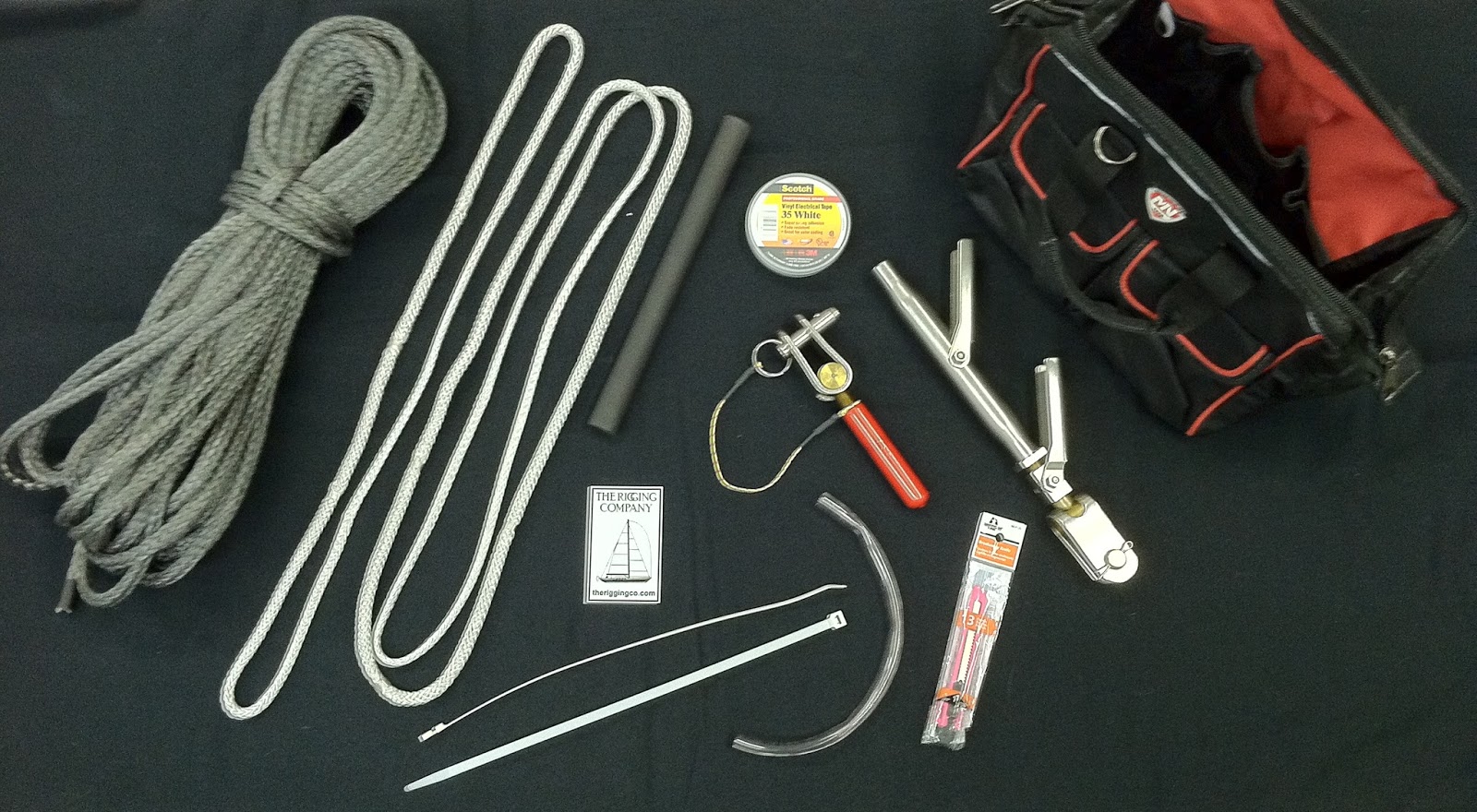
In event of a rigging failure, we carry a custom emergency rigging kit utilizing a series of Vectran lines and loops along with rigging turnbuckles that can be attached to the deck. The kit was designed by The Rigging Shop in Annapolis, MD and everything fits in a small black satchel.  

Deck & Cockpit


Boats come in two basic designs, those with the cockpit at the aft end of the boat and those with a center or mid cockpit. We have come to enjoy sailing the mid-cockpit design of the Taswell 44. You sit higher on the boat and more forward so you have increased visibility that is a tremendous advantage when sailing offshore. It is also a little drier given its height about the water. The Taswell's cockpit is on the small side (which is desired for an offshore boat) and features stylish rounded corners (like a big bath tub). Teak grates cover the floor of the cockpit.


All sail control lines are lead aft to the cockpit to reduce the amount of time anyone has to spend on the foredeck. The main sail uses the Antal battcar system and has two reef points and a Doyle StackPak to make raising/lowering the sail much easier and safer. Both the genoa and staysail are roller furling and can be reduced in heavier weather. We also have a 400 sq. ft. storm trysail that is rigged to a separate track on the mast. At the base of the mast are two "granny bars," heavy stainless steel bars that support the person working at the base of the mast. Forward are two large hatches for the guest berth, a small hatch for the forward head, and a large hatch for the forward anchor locker. At the bow of the boat is a Maxwell 2200 bi-direction windlass with remote control that is connected to a 73 lb. Rocna anchor with 260 ft. of 3/8" chain. The Rocna is probably the best money we spent on the boat for it's given us many a restful night in heavy winds. It has never failed to set or dragged at anchor in winds up to 40 knots. We use a 25 ft. 5/8" three-strand anchor snubber to ease the load on the windlass when anchored.  


The view from aloft shows the 750 watt solar panel array over the bimini and rear davits.
Specifications
  • Builder: Ta Shing 
  • Year Built: 1999 
  • Designer: Bill Dixon 
  • L.O.A.: 44' 
  • L.W.L.: 38' 3" 
  • Beam: 13' 8" 
  • Draft: 6' 1" 
  • Mast Height: 61' 
  • Gross Ton: 19 
  • Net Ton: 17
  • Actual cruising weight:  41,000 lbs.
  • Ballast: 9600 lbs. internal lead  

Machinery

  • Engine: Yanmar 4JH2-TE turbo-charged diesel 62 hp. 
  • Alternators:  12v and 24v Balmar alternators 
  • Fuel Filters: Racor 500T primary and Yanmar secondary 
  • Transmission: Kansaki RATIO: 2.62 : 1 
  • Packing Gland: PSS dripless 
  • Propeller: 21" diameter 3-blade bronze MaxProp 
  • Propeller Shaft: 1.5" diameter stainless steel 
  • Propeller Protection: Keel lower 
  • Rudder: Skeg supported fiberglass  

Electrical Systems

  • Aux. Generator: Ample Power/Phasor, Kubota EL-300 diesel engine turning a Balmar 95 Series 24V 140 amps 9594-140-24-IG alternator
  • Solar Power: Two Kyocera KD135GX-LPU @135 watts feeding into a Blue Sky Energy 1524iX with Maximum Power Point Tracking Photovoltaic Charge Controller 
  • Batteries: 24v House Bank: Four 6-volt Lifeline AGM GPL-L16T and two 12-volt Lifeline AGM  GPL-30HT for 650 amp/hrs. @ 24V or 1300 amp hours at 12 volts
  • Batteries: 12v House Bank: Lifeline AGM GPL24T 80amp/hr
  • Batteries: 12v Starter: Lifeline AGM GPL-27T 80 amp/hr 
  • Lighting:  24-volt DC, LED
  • Fans in all interior lockers for mold/humidity control 

Tankage

  • Fuel: Diesel 118 gallons
  • Water: Three tanks of approx. 49, 48.5, 44 for 141.5 gallons total capacity  

Walter Maker

  • Water Maker: Spectra 200T 24 volt (runs off of solar cells)
  • Capacity:  8 gallons/hour @ 5 amps 

Anchoring

  • Ground Tackle: 73 lb. Rocna anchor with 260 feet of 3/8 inch BBB chain
  • Ground Tackle: Fortress FX37 with 100 feet of 3/8 BBB chain and 300 feet of 9/16 line
  • Ground Tackle:  Spade S100 44 pound steel anchor
  • Anchor Windlass: Maxwell 2200 24-volt DC bi-directional with remote 
  • ShurFlo sea water wash-down hose on foredeck  

Electronics

  • VHF Radio: Standard Horizon GX2150
  • SSB/Ham Radio:  ICOM 802 with antenna tuner
  • Satellite phone:  Iridium 9575 w/external antenna
  • Satellite email:  Iridium Go w/external antenna
  • Weems & Plath electronic barometer
  • Chart Plotter: Raymarine SL70C 
  • Radar: Raymarine RL70
  • AIS: Vesper XB 8000 with external antenna
  • Auto Pilot: W.H. Autopilots Inc. (hydraulic ram) with remote 
  • Depth Finder: Raytheon ST60 
  • GPS: Northstar 941X 
  • Knotmeter: Raytheon ST60 Speed 
  • Antennas: Two VHF, GPS, radar, satellite radio, AM/FM, SSB, television, SSB 
  • Compass: Ritchie Globalstar 6"  

Plumbing and Ventilation

  • Air Conditioning: MarineAir VTD8K-410A 8000 BTU 
  • Hot Water: Sigmar Terminox, 11 gal electric with engine heat exchanger 
  • Five dorade ventilators, three with guards  

Spars & Rigging

  • Mast: Main (aluminum) Lightning dispersal brush and tricolor navigation light at masthead
  • Mainmast safety bars and lower steps 
  • Forespar rigid boom vang 
  • Firdell Blipper radar reflector 
  • Storm trysail track on main mast 
  • Two mechanical backstay tensioners 
  • Two running backstays 
  • Stainless steel antenna and radar mast 
  • Folding stainless steel swim ladder on transom  

Sails

  • Main:   Ulmer Kolius with two reef points
  • Genoa:  Neil Pryde120%
  • Staysail: Ulmer Kolius
  • Code Zero/Drifter: Quantum
  • Storm Trysail;  Rolly Tasker with reef points
  • Doyle StackPack
  • Mainsail control with Antal batt slides 
  • Harken genoa furling system
  • Harken staysail furling system 

Galley

  • Stove: Force 10 3-burner propane stove 
  • Microwave: Cuisinart microwave oven 
  • Refrigeration: Glacier Bay 12-volt DC refrigerator/freezer with holding plates 
  • Fresh and sea water foot pumps and spigots at galley sink  

Safety And Fire Fighting Equipment

  • Emergency tiller Flares: West Marine Flare Kit 
  • Bell: Brass Bell 
  • Life Jacket: Four Type III Type IV 
  • Throwable: LifeSling and Rescue Line 
  • Life Raft: Winslow Offshore Plus 6-man 
  • Fire Extinguishers:  Four 10 B:C and two 40 B:C dry chemical  

Winches

  • Genoa Sheets:  Two Lewmar #54 2-speed self-tailing
  • Staysail:  Two Lewmar #40 2-speed self-tailing
  • Halyards:  Two Lewmar #30 2-speed self-tailing
  • Mainsheet:  One Lewmar #44 2-speed self-tailing
  • Traveller:  One Lewmar #16 single speed
  • Halyards:  Lewmar #44 2-speed self-tailing
  • Halyards:  Lewmar #30 2-speed self-tailing

Tenders

  • Tender: Achilles HB310 PG 10' 2" with Yamaha Enduro 15 hp. outboard