Sunday, November 19, 2017

Australia: The Last Leg

We departed Southport on the ebb tide hoping for a quick run down to Sydney in predicted light southerly winds. Unfortunately when we rounded the breakwater the wind was a steady 22 knots and higher, right on the nose. Our friends on Plastik Plankton who left just ahead of us took a starboard tack to get further offshore in an effort to clear well named Danger Point. We opted to motorsail directly into the wind hoping it would let up or change direction. At times we were making on 1.5 to 2 knots to weather, with large waves slamming into the hull. My hope was once we got closer to Danger Point the wind would shift and give us a better sailing angle, but it didn’t.  It took us over 10 hours to clear the point where we could ease off on our course and at least sail close hauled, not what we had hoped for on this final leg of our six year odyssey.
On our second day at sea the direction of the wind eased allowing us to sail close hauled towards our destination.
We opted to check into the Australian Marine Rescue Service coast stations as we worked our way south along the coast. A volunteer service, stations are placed about every 50 to 60 miles along the coast with volunteer staff who monitored both VHF radio and cell phones. We would check in and give them our ETA to the next station. If we didn’t check in to the following station by the appointed time we would get hailed on VHF radio or a cellular phone call. If there were an issue, each station has a high speed rescue craft (usually inflatable RIBS) that can respond quickly to any emergency. I have to say this gave us tremendous peace of mind as we transited this very dangerous coast.

As we progressed further south the coast line moved more to the west allowing us a better sailing angle, finally to the point of some very enjoyable sailing as we approached the Pittwater area. We could see the lighthouse at Barrenjoey which guards the entrance to the Pittwater area. Think of Pittwater as a mini Puget Sound, with hundreds of miles of shoreline inside the protection of the coastal hills.

Weaving our way through the race boats in Pittwater. They race almost every day of the week here.
As we worked our way south towards our destination of Newport we were amazed at the number of boats, especially sailboats, out on the water on a Wednesday. We literally had to remember the racing/right of way rules as we weaved our way through a group of boats on the reaching leg of the race course. Soon the water was covered with moored boats, more than I’ve every seen in one place in my life. Luckily the guys from the brokerage came out in a small boat and guided us to our mooring buoy just off two major yacht clubs near Newport. 

It was a tremendous feeling knowing this was the last time (probably in our lives) that we would tie up to a mooring buoy and end a voyage. We’d had two overnights, so we were both very tired and had a quick dinner and then collapsed into bed with a great sense of relief that we had finally reached our destination. 
A typical house in the neighbors. Prices start at about $1,000,000 for waterfront views.
The next day we took the dingy into the small marina where our broker was located, met the office staff and got a quick 411 on the local area. We then walked about six blocks through a rather posh neighborhood (Newport is a very affluent area) to Barrenjoey Road, the main thoroughfare from Sydney to what are called The Northern Beaches (mainly Mona Vale, Newport, and Avalon). We were pleased to see lots of neat restaurants, bakeries, shops, and a great Coles grocery store. After a relaxing Thai lunch we stopped at a physiotherapy clinic where I signed up for some sessions to get my stiff knee back into shape. Next was a visit to Coles were Meryl stocked up on supplies, the bakery for fresh bread, the news agent to buy our Opal bus passes, and then a nice walk back to the boat.

On Friday our broker, Rod Waterhouse, took us on a cook’s tour of Newport and Mona Vale to check out the local marine chandlery, a storage place where we can offload stuff from the boat, and a neat restaurant complex called The Newport.

In subsequent days we rented a car from a local guy and secured a 4.5 square foot storage locker and began hauling loads of extraneous gear off the boat. We hope to sell most of it locally and ship the rest back to Bend, OR. 

My computer was still an issue so we took it up to the local Apple retailer but were told it was too old to work on. After exploring other options I decided to buy a refurbished unit from Apple in the US and have our friends the Ballews bring it with them the following week. Naturally just after I did this one repair shop I’d contacted online gave the email address of another repair guy in Melbourne who did motherboard level repairs. I talked with his Chinese wife, and later that day sent it via Express Mail to Melbourne and amazingly had it back with two days. The repair meant disabling one graphic chip, which means I can’t hook it up to an external monitor, but otherwise it works great.

Just a side note, it’s amazing in Australia how well stuff works, such as the Postal Service. They don’t want UPS to take over deliveries like in the US so they offer stellar service. When I shipped my package to Melbourne I received emails informing me of its location along the way. The bus service is similar. You buy an Opal Card (like a credit card), load money on it at any 7-11, and tap it on a reader as you get on and off the bus. No worries about carrying money or exact change. And it works on toll bridges, trains, etc. Most Americans are unaware how much we are falling behind other countries in areas such as transportation, airports, and mail delivery.
Meryl browsing at the Avalon Market.
There are beaches like this all the way along the coastline from Sydney northwards.
On Saturday Nov 19th we took the bus five miles north to the town of Avalon, which was hosting it’s once-a-year Market Day. There must of been over 500 booths and stalls selling everything under the sun. Meryl was in 7th heaven just browsing at all the clothing shops. Afterwards we went across the street to the Avalon beach where a gently surf was rolling in. All the public beaches have a specially built “swimming pool” area (usually made out of rock and facing the ocean so waves keep it filled with fresh water). It must be nice to swim in a protected area without having to worry about a Great White Shark having you for dinner.


Friday, November 10, 2017

Australia: Getting Accustom to Customs

We had spent a lot of time researching and planning our passage to Australia as we’d heard Australian Customs was one of the toughest in the world. Our plan was to sail from New Caledonia on a more southerly route to Coff’s Harbor, a smaller port north of Sydney with less strict Customs and BioSecurity. Unfortunately with the storm coming out of the south we had no choice but to sail a more direct westerly route into Southport. The problem was that Southport’s Custom’s, Immigrations, and BioSecurity people were headquartered in Brisbane, well known as one of the strictest ports on the coast.

Soon after we arrived at the luxurious Southport Yacht Club, Australian Customs showed up. They were very professional and checked us in with minimum hassle. Since we still weren’t 100% sure we were going to sell the boat in Australia, we deferred on importing the boat at that time. Next was BioSecurity. Think of yellow hazmat suites. They were the ones we were most concerned with since they had a reputation of confiscating various foodstuffs and other items. We got a senior offical with two trainees, not a good sign. They were also very professional, but when they snapped on their latex gloves and got out their CSI lab kits, we knew we were in trouble. First they went through our fridge and food storage area, confiscating some fruit, vegetables, and other items. 

Next was the bug hunt. For the trainees, eager to make a good impression on their boss, our boat was Nirvana. Flying Cloud was a Taiwanese-constructed boat full of teak and other wood, which could be home to any number of nefarious beasts. They looked in every compartment on the boat, taking samples with their tweezers and putting them into little glass vials. They were mainly concerned with termites, looking for telltale sign called frass,  and God knows what was in our boat after visiting over 20 tropical countries. They got all excited when they found a small bit of yellow powder in a corner, until we told them that was left over from sanding the yellow glue that held on our old headliner. They said a more experienced officer would need to come the next day for a more thorough inspection. Ugh.
The crew from Plastik Plankton: Kathi and Wolfgang (Wolfie).
On the plus side, we loved Southport. Part of the famous Gold Coast of Australia, it featured endless white sand beaches, mountain range sized condominiums, and great restaurants. It was quite the culture shock after our time in stone-age Vanuatu. We finally got off the boat and walked down the street a bit where we met Kathi and Wolfgang from Plastik Plankton for a delicious fish and chips dinner. 
This is delicious, expensive food that Australia deemed "to dangerous for entry." Off to the trash bin.
The next day the A-team from BioSecurity showed up, a senior agent and another trainee. They also took the boat apart, taking various samples of whatever in their little glass vials. These would go to the lab for analysis, and they said depending on what the lab found, they might need to bring down the termite dogs later in the week. Double ugh. On top of everything else, they never looked at the bottom paint that I had painstakingly cleaned while in New Caledonia. Since a rare southbound weather window was opening the next day, we were greatly concerned we’d have to stay in quarantine in Southport, but they gave us permission to head south. The irony of all this is we never heard back from them, despite several emails to their office. Apparently we came out clean on the inspection.

On Nov. 11th we took the bus with Plastik Plankton over to the Australia Fair Mall, about four miles to the west. I spent most of the time trying to get my new SIM card working (turns out they never took out my old US SIM card) while Meryl and Kathi went grocery shopping. Again, very weird to be in a big fancy shopping mall after our experiences in Vanuatu. 


While we would have liked to stay much longer to explore Southport and the Gold Coast, we had to get ready to depart at 11:00 am the next day (to catch the outgoing tide) for our three-day sail to Pittwater, just north of Sydney.

Thursday, November 9, 2017

New Caledonia to Australia: A Tough Passage


As mentioned in our previous blog, we were in an quandary about our weather window from New Caledonia to Australia. Normally a six-day, 906 mile passage, our routing was complicated by an low gathering strength south of Sydney and predicted to head north up the Australian coast just about when we were schedule to arrive in Southport. All the other days looked fine, from light wind to 14 knots, but the the last two days were questionable. All three weather (computer) models disagreed, but one said winds could be southeasterly in the 25 gusting to 35 knot range. We agreed with our weather forecaster that if it looked like heavy winds were developing, we would take a more southerly course to try and “get below” the 9- to 12-foot waves and sail a more downwind course back up to Southport.

Ironically, as we departed Nge Island just west of Noumea, the wind was very light — in the 7 to 8 knot range — causing us to alternate between sailing and motor sailing. We had a full tank of fuel, but obviously wanted to minimize the amount of motor sailing we did.

While the weather was OK, Meryl had a sore throat that was getting worse as time progressed. By Day 3, I was also feeling a scratchy throat and a cold that was quickly going straight to my lungs.  While Meryl’s cold slowly progressed, mine took off like wildfire and I was coughing, fighting an excruciating headache, and having flu-like symptoms. Our routine quickly became me sleeping all the time I wasn’t needed on watch. I had no appetite and generally felt miserable. 

But the weather Gods didn’t care and over the days the wind increased. We decided to start sailing a lower, more southerly course to get below Southport so we could ride the heavier wind/waves more downwind and back to Southport during the last two days. That also meant sailing closer to the wind on a close hauled course, normally not a lot of fun during an ocean passage.

Out for the count.
In preparation for the stronger winds, I had to go up on deck and help Meryl jibe the boat. This meant bringing the preventer around to the other side, rolling up the genoa (ours won’t jibe or tack since the roller furling staysail is in the gap), and other adjustments. While normally a simple job, I had to rerun the preventer line three times since I was so sick I couldn’t think straight, and just keeping my balance on the rolling deck was a challenge. I almost fell overboard at least three times. Very scary stuff. After that I immediately went to bed and slept three straight hours until Meryl’s shift was up. I don’t think I’ve ever gone five days with no food, but I had absolutely no appetite. And of course, since we were selling the boat, we just wanted to get us and the boat to Australia in one piece. We’d suffered damage to the rig and sails in other storms and  we didn’t have the energy to deal with damage control in our current condition. I had to depend on Meryl for just about everything and she did a great job of filling in with the stuff I’d normally do.

A secondary concern was that almost all of the ports on the east coast of Australia are river bars, which meant that large southeasterly or easterly waves could easily shut down the entrance to the port. Luckily our friends Kathi and Wolfgang on Plastik Plankton had just cleared the entrance to Southport in similar conditions, and while it wasn’t fun, they did say it was doable. That gave me a huge sigh of relief since the idea of heaving to outside the bar in heavy waves was not something I looked forward to.

The storm trysail worked perfectly in the heavier winds and seas. Like we were out for a Sunday sail.
When we originally bought the boat six years ago I had a storm trysail made by Neil Pryde Lofts in Thailand. The sales guy said you’ll probably never use this sail, but if you need to, you’ll be very glad you have it. By Day 4, with the winds predicted to increase to a steady 22 knots plus, we decided to lower the main sail (which has only two reef points) and hoist the storm trysail. It sits in a bag at the base of the mast and has it’s own sail track. Since we’d only hoisted it once at the dock, we weren’t totally sure how to rig it. Turns out it was very simple to attach snatch blocks to the aft mooring cleats with Dyneema loops and run the sheets through the blocks and back to the big sheet winches in the cabin. The sail is bright orange and made of 9 oz. sailcloth, the equivalent of a sheet of plywood. It set beautifully and even with the winds hitting 25 to 30 knots, the boat was totally under control. I so wish we would have used this sail when we got caught in the storm off Tonga. We also flew our staysail so we had total control of the boat in the heavier winds, with a boat speed of about six knots. What a relief to not have to worry about the main sail getting trashed in the heavier winds.

We were now sailing close hauled trying to get far enough south to ensure a downwind  entrance into Southport. In retrospect we probably could have just maintained our rhumb line and gotten in a day earlier, but we had little experience with the storm trysail and didn’t know what to expect.

By Day 6 we were predicted to get in to Southport at around 9:00 pm. I didn’t want to enter a narrow pass at night in an unfamiliar area, so we decided to see how the boat would heave to (a method of slowing the boat down with little forward movement). We had tried it before with our mainsail, but it was too big to balance with either the genoa or staysail, so we tried it again with the smaller storm trysail and it balanced perfectly, even though we were more forereaching than heaving to. In forereaching the boat makes very slow progress to windward, although it is still sailing, where in heaving- to you are more stalling out the boat while pointed just off the wind. All of a sudden the boat became calmer and life was more livable down below without the constant banging of the waves against the forward hull.

Our new vinyl side curtains kept the breaking waves from dousing the cockpit. This was especially disconcerting when you were on night watch and had just put on your last pair of warm clothes and a big wave crashes over the side.
We both relaxed and slept, checking for boat traffic and AIS targets about every 20 minutes. Another huge change on this passage was we had our new vinyl side panels installed, meaning waves could no longer roll up the sides of the boat and be blown into the cockpit soaking us with salt water. The temperatures at night were definitely cooler now that we were further south, so it was a huge advantage for us on this passage.

Land Ho! The towering condos of Australia's Gold Coast.

I don't know if you can tell by our expressions, but it was sheer relief to have just sailed 17,000 miles, across two oceans and numerous seas over a six-year period, and having made it alive.
We were also now running downwind which added to the comfort level. By daybreak we could see the towering condominiums of Australia’s famous Gold Coast and eventually picked out the narrow pass leading into a vast inland waterway/canal system typical of this part of Australia. As we approached Southport we could see waves breaking against the south side of the breakwater, but they didn’t look like they would be a big issue. We contacted Marine Rescue Southport and they advised us to stay mid channel since a shoal was developing on the normally deeper north side of the channel. We got a little ride surfing in as we rounded the breakwater but nothing that Flying Cloud couldn’t easily handle.
We have never  been so happy to be tied up to a dock with the realization that we were finally safe and back in civilization.
We were so relieved  when we finally round the corner of the pass and sailed into the relatively calm (although still very windy) waters of the inside passage. Now the only thing we had to deal with was tying up at the dock and of course Australian Customs and Immigration.  More on that in the next blog post.

Wednesday, October 25, 2017

Our Last Island Paradise: New Caledonia


Given a fairly decent weather window, we decided to leave Port Vila for the three and one/half day, 327-mile voyage to New Caledonia. On Oct 21st, we departed Port Vila in a nice southwesterly and quickly fell back into our offshore mode of three hours on watch and three hours off watch. Since your circadian clock gets completely out of whack on passages, we mainly just sleep at every opportunity we have. We sailed through the Loyality Islands along a rhumb line for Havannah Channel on the southeast side of New Caledonia. The channel is rather notorious for strong currents so we planned our passage to ride the flood tide in through the pass early in the morning. We were accompanied by Pandora and our old friends from the Galapagos, Geoff and Allison on Saroni. Allison has a very distinctive radio voice and it's always great when she is a net controller on the MagNet as everyone can hear her.

The hills along Havannah Pass are covered in Pine trees, a very unusual sight in the South Pacific. New Caledonia is also very rich in minerals and has over 25% of the world's nickel deposits.
We spotted the rust-colored cliffs along Havannah Channel and marveled at the size of New Caledonia. It is famous for very rich mineral deposits, including over 25% of the world’s nickel deposits, and the income from the mining provides for a very nice lifestyle for the French inhabitants.

Eventually we wound our way through various passes and channels and finally approached Noumea around noon. We talked with the marina but there was no space available so we eked out a very questionable spot just outside the legal anchoring zone. Once again our friend Neil on Pandora offered to give me a ride down to Immigration, where his fluency in French made the process go much smoother. As a former super yacht captain he knows all the ins and outs of the customs/immigration process.

The Port Captain hailed us from his launch asking us to move so this cruise ship could enter the harbor.
 Sure enough at 6:00 a.m. the next morning the Port Captain hailed us from his launch and said we'd have to move since a big cruise ship was coming into port. We'd been warned this might happen, but hoped it wouldn't. So still half asleep we meandered a bit east and found a good anchoring location amongst several large American cats, all waiting for slips in the marina like us.
It is hard to describe your emotions after several months of cruising in Third World countries and to come upon a French patisserie.
Our friends Kathi and Wolfgang had been in Noumea for several weeks already and gave us some tips on where to buy food and some good restaurants. Our first stop was an offical little French patisserie (just like in Paris) where we got fresh baguettes and some other French pastries. We thought we’d died and gone to heaven.

It is very easy to fall in love with the city of Noumea. As we said, the standard of living is very high here (the mining companies pay very good salaries to the French employees) so there is a plethora of good grocery stores, patisseries, and wonderful little French restaurants (albeit very expensive compared to Vanuatu). 

My first task was to try and get my broken MacBook computer fixed (I had gotten the broken hard drive fixed in Fiji but now the video card died), but the Mac store said it would take three weeks just to order the part. Dejected, we walked around the corner and found a wonderful lunch place where they made fresh salads (you walk down a counter and point to what you want). The best part was they gave you a small cup for frozen yogurt and goodies from their self serve machines. I learned you could get the yogurt (I have no pride when I’m hungry) to stand about six inches tall in the cup if you were very careful when you served it. It was some of the best frozen yogurt I've ever had.

The indigenous Kanak people are descendants from the Melanesian people from Asia.

The Kanaks were divided into clans and lived a simple life based on subsistence fishing and hunting. Like the Vanuatuans, the men customarily wore a penis sheath, and not much else.

One interesting aspect of New Caledonia is the indigenous natives, the Kanaks, were still very disenfranchised. Today they represent about 39% of the population. You'd see them walking around in groups with their hoodies over their heads with seemingly nothing to do. If you are in New Cal and are French, life is very good. If you are a Kanak, it's a different story.

Meryl was in seventh heaven shopping for fresh vegetables at the various stalls at the City Market.
The sheer quantity and quality of the food in the City Market was overwhelming.
There was a large variety of art from the indigenous Kanak people at the Market.


A live band played an eclectic set of tunes during the Saturday morning market.

There was a wonderful City Market near Port Moselle Marina that had some of the best fruits and veggies we'd seen in a long time. There were also stalls selling French dresses and all sorts of other items, along with a live band playing. The big thing to do is go down early in the morning and get a croissant and a hot coco and just sit and enjoy the ambiance. After the dearth of good food since Fiji, we thought we were in a culinary wonderland.

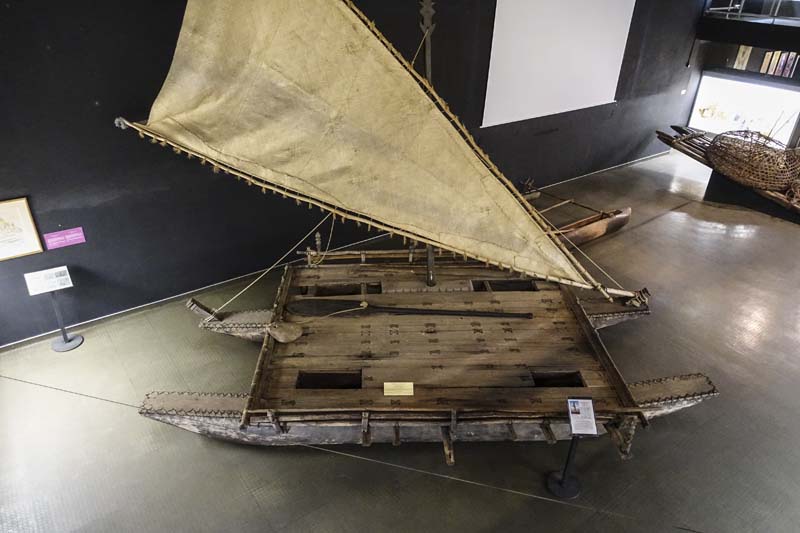
These are the local sailing craft used in the early days in New Caledonia.

We went to the National Museum the next day which had a surprising good collection of Kanak artifacts and other historic items from New Caledonia's early days. It was interested to learn of their culture (they come from Melanesian stock, different from most other South Pacific island).

A cruiser friend of our who is a "foodie" recommended this restaurant for Meryl's birthday. It was an excellent choice.
Meryl's fillet of sole was excellent.

A terrible selfie but a reminder of one of the best meals of the last six years of cruising.
On Oct. 28th, for Meryl's 69th birthday, we decided to splurge and went to La Table des Gourmets, which was recommended by a fellow cruiser. I have to say the French are among the best cooks anywhere, and our meal was outstanding. I had a pork roast that literally fell apart when touched by a fork, and Meryl's fillet of sole was one of the best she'd ever had. For dessert we tried a mullineaux chocolate which was a small chocolate cupcake filled with delicious hot chocolate. It was so rich you had to eat it very slowly and between the two of us we couldn't finish the whole thing.

The World War II museum was small but did an excellent job of depicting life in New Caledonia during the war

We spent most our days just exploring the small city, and one of our super finds was a patisserie called Le Petit Choux. It was outstanding. That day we also visited the World War II Museum near the north end of town. It was housed in an original Quonset Hut and had excellent displays of life in Noumea during the war.  New Cal was just south of the islands where the major fighting took place and served as a resupply station for the ships/airplanes and an R&R station for the American troops. They had some great videos of the soldiers going water skiing, hanging out at the beach, and socializing with the the young French women, who apparently liked Americans a lot. I wish my Dad were alive so I could hear the stories of when his submarine stopped there.

Students from the Conservatory of Music in Noumea put on an excellent show at the marina bar. The French certainly know how to have a good time.
Daren was kind enough to share his table with Meryl and I. Little did we know he was a Methodist minister from Australia. 
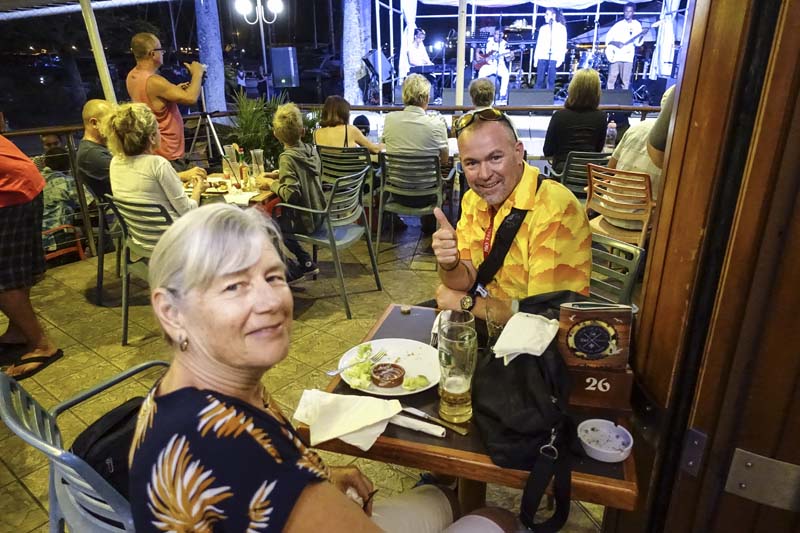
On our last night in Noumea we went to the Brasserie at the marina where a local music school was showcasing the various bands from the school. They were an eclectic bunch, but very talented and entertaining. The place was packed and we found a single guy siting at a table and asked if we could join him. He looked like a rugby player, but was actually a Methodist minister from Mooloolaba in Australia. And like most Australians, the guy could drink beer with the best of them. His name was Daren and he was visiting via a cruise ship from Brisbane. We had a wonderful time learning about Australia and wondering if the Methodist Church had changed since our days. After he left we met up with the crew of Pandora and enjoyed some more excellent French beer and entertainment.

The next day we debated when to leave New Caledonia for Australia. It’s a major passage and we wanted to get the weather window right. Neil mentioned they were clearing out that day and asked if I wanted a ride down to Customs. Seemed like it had become a tradition after our last three countries, so I said sure. As usual, checking out was fairly easy but we did have to walk about two miles from Immigration, to Customs, and finally to the Port Captain at the far end of the Port. Nice to have someone to talk to during all the trekking.

We left later that day and sailed a short distance out to Isle Nge, where we saw Pandora for the last time as they were sailing for Australia that afternoon. We had been working with a weather router to get the weather figured out and it looked like the first two days would be very light if we left then, so we decided to wait for one more night before departing. Pandora was taking a shorter route to Southport (just south of Brisbane), whereas we wanted to head further south to Coff’s Harbor where we were told Customs was a little more lenient.

We envisioned a quiet, idyllic few days anchored in the lee of this beautiful white sand beach island, but a strong 22-knot wind kept us pinned on the boat for most of the time. I did get a chance to dive on the bottom to make sure it was squeaky clean for Australian BioSecurity, who have a reputation for being very tough about food, bottom paint, and anything else that pops into their minds. More about this later.

Since you have to plan the weather for at least seven days out, we were flummoxed when the three computer models used for weather prediction could not agree on when a nasty storm would make it’s way north from Sydney to Coff’s Harbor and possibly further north. We made the decision to leave earlier, rather than later as planned and to shorten our trip by sailing just south of Brisbane to Southport. 

We bemoaned having to leave New Cal so early, as we wanted to visit the outer islands and just hang out for awhile, but the storm concerned us and we needed to get going. We prepared the boat and got an early start in the morning of Nov. 2nd for our last ocean passage in our lives. We had hoped it would be an easy one, but it turned out to be one of the more difficult passages.

Friday, October 20, 2017

Retreat to Port Vila

We waved goodbye to the John Frum cargo cult guys, who I'm sure were disappointed that we didn't bring untold riches to their island, and departed Tanna Island on Sunday morning, Oct. 15th. A strong front was coming northwest from New Caledonia and we didn't want to get stuck in Port Resolution with a large swell curling around the point. We had a choice of trying to outrun the storm to New Caledonia, or retreating northeast to the protection of Port Vila. Given our past experience trying to outrun storms we opted for the conservative approach and headed to Port Vila.

We expected a pleasant downwind sail, but when we got between Tanna and Erromango Island the wind funneled and all of a sudden we were hauling in 25-knot winds. It calmed down a bit after that and we had a non-eventful downwind sail into Port Vila on the Vanuatu island of Efate.

This is the inner harbor at Port Vila. You can just make out the power lines at the far right edge of the photo. The trick was to get close to shore where they are a little higher up.
We only had some old cruising guides on Port Vila and there was a lot of discrepancy as to 1) the depth of the sandbars you sailed over to enter the inner harbor and 2) the height of the power lines you had to cross under. Our charts showed 8 ft. of depth for crossing the bar and 62 ft. of clearance for the power lines (our mast is 62 ft. high). Another guide said there was 90 ft. clearance. We finally raised Yachting World who rents out the mooring balls and they said "No problem" (in only the way French speakers can say it) and said they'd send out a launch that we could follow in. I kind of just closed my eyes as these guys took us on a weaving course close to shore, but I never saw less than 12 ft. on the depth sounder and we cleared the power wires by at least 10 ft. So much for cruising guides.

It felt good (as it always does) to get tied up to a mooring ball and be able to relax for awhile. We headed in to meet Customs at the Yacht Club (relax, it just a small sparse office) just as a bunch of French sailors from New Caledonia arrived. They had participated in the Noumea to Port Vila Sailing Rally and naturally thought they owned the world. More on this later. We finally got cleared in and headed down the main street of Port Vila to explore the town and search for frozen yogurt.

If you've ever read any of Martin Troost's books (Getting Stoned with Savages) you'll learn a lot about Vanuatu and Port Vila. At one point the town became an offshore money laundering haven with several casinos and fancy hotels. But after many indictments and imprisonment of government officals, things have calmed down and now it's just a nice little town visited twice weekly by cruise ships from Australia.

I was searching for a 12v to 220v inverter so I could run my new Windows laptop and suprisingly found a fairly decent Chinese made unit in a local shop. We bought our requisite phone cards so we could get Internet and even found several good ice cream stores. It's a nice town and they did a great job creating a waterfront walkway (where the cruise ships come in) with lots of good restaurants, shops, etc.

It's hard to explain how finding a nice air conditioned restaurant, and sitting down to a cold Coke and fish and chips is such a treat to us. Just like we're back in the real world again.
This is one happy lady after lots or tiring overnight passages to reach Vanuatu.
They did a great job with the redesign of the waterfront near the cruise ship terminal. There are kid's playgrounds and lots of great little restaurants to hang out in.
The round dome in the middle of the photo is the new convention center, perched on a hill overlooking downtown Port Vila.
Inside the convention center is this "coat of arms." If you know Bislama, the local pigeon English, you can figure out what the plaque says.


We took a long walk the next day and saw the huge new convention center that the Chinese financed for the locals. It's amazing the amount of influence China has garnered in the South Pacific, all looking for UN votes to support their various political goals.

Meryl loves smelling and pinching all the local foods, much to the chagrin of the stall's owner.

Fresh yams are packed in local palm leaf carriers.

The entire family typically works at the Public Market stalls helping clean and parse the vegetables.

We ended up at the Public Market, a fairly good one as public markets go in Third World countries. Meryl always loves exploring the various local food offerings and trying to figure out what everything is. I mainly tease the young kids hanging out with their moms working in the stalls and try to learn the English names for the various foods. The kids always get a laugh from my feeble attempts at pronunciation.

As mentioned in an earlier post, the Vanuatuan's come from Melanesian stock and don't have the fine features of the Polynesians or even the Fijians. They are very nice and gentle people and it's always fun to try and strike up conversations or ask questions.  We've gotten so good at sign language and other ways to communicate that not knowing the language has never been a problem.

These women from a remote island were very proud to have "Best Display" in the competition at the Agricultural Fair.
The second place team poses for their photo op.

Sweet chili sauce has become one of our favorite condiments.
We had a fun time during one of our our walks when we discovered a huge agricultural fair (just like the one on Tonga) called the Pacific Week of Agriculture. Hundreds of tents were set up with various displays of local agriculture, fishing, and farm animals. We loved visiting the various tents representing goods and products from different islands/regions. The ladies were all dressed in similar dresses and one team had just been awarded the "Best Display" while we were there. Quite fun.

The big draw at the fair was the portable saw mill, which ripped large logs into usable lumber.
The most popular booth was one with a portable saw mill set up and three guys cutting lumber from large trees. Reminded me of the booths at the Western Washington State Fair every September. Loud, noisy machines still draw a crowd.

Jaywalking is easy here since the traffic crawls along at a snail's pace.
One thing that was hard to get used to was traffic. They use private mini vans for their bus system and the roads were literally grid-locked with hundreds of these vans bumper to bumper. The good news was you could get places fairly cheaply, it just took awhile. We had a fun time riding around trying to find a propane (BBQ) lighter for our stove. That took one half a day.

Site of the near international incident when I politely refused to go to the back of the line. The Brits just out of the picture gave me a big thumbs up.
On Friday the 20th we went up to the Yacht Club to check out for our trip to New Caledonia only to have all our friendly Frenchmen from the sailing rally show up again. I was near the front of the line when the rally leader came over and politely said I should go to the end of the line so the rally participants could clear out first. I politely explained to him why that was not going to happen. Several Kiwis and Brits sitting nearby smiled at me and gave me a thumbs up. We've had lots of experience with various local and round-the-world rally's blowing into town and thinking they owned it. The cruising community takes a very dim view of this practice and tries to avoid these rallies like the plague.

We departed later that day once riding on the coattails of a front that had just passed through, hoping the seas had calmed down enough for a pleasant voyage.


Tuesday, October 17, 2017

Under the Volcano

We had vacillated between sailing to Vanuatu or just continuing straight to New Caledonia, but the night before our departure Meryl read a stirring blog description of s/v Georgia's visit to Tanna and the hook was set. As you read in the previous blog, our passage between Fiji and Vanuatu was not without drama, but we were happy as the mountains of Tanna Island peaked out from the clouds early in the morning and we made our way into the safety of Port Resolution Bay.

Earlier visitors to Vanuatu also had their doubts, and the reason the islands weren't easily converted to Christianity is because the Vanuatuan's had a habit of eating the missionaries. We heard the last known act of cannibalism in Vanuatu was in the early 1960s, not that long ago. We had no plans of proselytizing so we felt we'd be relatively safe.

Port Resolution was first visited by Captain James Cook and named after his ship.
The entrance into Port Resolution has not changed much since Captain James Cook arrived in 1774. We rounded the corner of the bay and found about 10 sailboats bobbing at anchor, the result of a light swell that rounded the corner of the otherwise well-protected bay. Only a few grass-roofed structures could be spotted in the entire bay.

Cruisers go to Tanna Island for two reasons: to climb an active 1,184 ft. volcano named Mt. Yasur, and to learn more about the infamous John Frum Cargo Cults.

The eclectic Port Resolution Yacht Club main dining room.
Since Port Vila on Efate is the only official port of entry, we had to make prior arrangements with Vanuatu Customs/Immigration to meet us at Port Resolution (named after Captain Cook's vessel) to clear in. Another cruiser offered us a ride into the Port Resolution Yacht Club (don't get too excited, it's just a rudimentary thatched-roofed hut) to meet the Customs officials. Two other boats were also there and we split the cost four ways to cover the costs for the Customs officials to drive two hours from their offices in Lenakel on the other side of the island.

We met Stanley, who runs the "Yacht Club," and his cousin Wherry (the local Chief's son) who are the "go-to" guys that arrange things on Tanna. You have to remember there is just the Yacht Club, some backpacker cottages, and a small village. No stores, no infrastructure, no nothing at Port Resolution. If you don't have Vatu money you have to endure the four-hour, bone-jarring ride into and back from Lenakel.
Merriam, the local teacher, gives us a tour of Ireupuow village.

This little girl was determined to beat her brother to the top of the tree.
We made arrangements with Stanley to go up the volcano in two days and then wandered down the road to the local village, Ireupuow, where we met Merriam, the village's school teacher. She was nice enough to give us a tour of the village, including the school, two rudimentary churches, and a beautiful white sand beach. She showed us a house being constructed by a group of Australian students and mentioned someone wanted to build some sort of resort on the island. We promised Merriam a bundle of school supplies for the kids, a bag of reading glasses, and some very high tech line to build the younger kids a swing.

Back at the Yacht Club we met three French girls from New Caledonia and asked them if they wanted to join us and visit a John Frum village the following day, Friday. If you have read James Mitchner's Tales of the South Pacific you know about John Frum and cargo cults. Tanna Island is the home base for Cargo Cults in Vanuatu. The short version of the story is US Marines/Army landed in Vanuatu during World War II, bringing with them huge amounts of vehicles, supplies, food, and constructing towns almost overnight. The Yanks were very friendly and open to the locals, something they had not experienced from the Europeans. The Vanuatuans were also impressed by how blacks and whites worked side by side in the Marines, and the fairness with which the multi-racial American troops treated each other.

After the war, cargo cults developed worshiping a fictionalized American called "John Frum" (which people think is an aberration of "Hi, I'm John from America"). They believed if they honored the Americans they would return with their mountains of cargo. Sulphur Bay, where we attended the John Frum dancing, is the epicenter for the Cargo Cults in Vanuatu. Many villagers believe John Frum and his followers live in the nearby volcano. As part of the Cargo Cult culture, men wear Army jackets with American flags on the shoulder, Red Crosses can be seen on the buildings, men sometimes march with wooden rifles, and somewhere the John Frum followers even built an airfield with wooden airplanes to entice the Americans to return.

The booms from the nearby volcano serve to magnify the surreal vibe of the John Frum village.
Our visit, after a bumpy ride halfway up the volcano and down the other side to Sulphur Bay, was somewhat anticlimactic. On each Friday the various cargo cult villagers assemble in Sulphur Bay village for singing and dancing. The problem was each village group gathered under a thatched roof hut in a tight circle with their guitars and sang what sounded to us like a very repetitive series of songs, the lyrics of which I assumed was to entice the Americans to return.

As each subsequent group sat down to sing, the songs all had them same tenor and rhythm.


Well, we were Americans and we had returned, but no one paid us any attention. What was interesting is the village is situated right next to the volcano and sudden booms resonating from the crater scared the pants off of us numerous times. You could see the red glow of the volcano pulsating right behind the village. It was a very surreal experience for us.

The next day at 3:00 pm we met Assam, our 4x4 truck driver, for the 45-minute ride to the base of the volcano. As mentioned, we have only experienced roads this bad during our safari in East Africa. The truck litteraly crept along as its suspenion performed feats of magic climbing over washed out sections of the road and tipping to precarious degrees of balance.

Meryl receives the traditional flower greeting from one of the Vanuatuan hostesses.
We arrived at the Volcano Welcome Center around 4:00 pm, paid our US$97.00 entrance fee and gathered in an open area organised by country flags (so they could handle the various languages). There were intrepid tourists from Australia, France, China, and other countries waiting to ascend one of the few accessible active volcanos in the world. Following a local dance asking the God's for a safe visit, and a short briefing, we climbed into 4x4 trucks for the 20-minute ride up to the volcano. Emerging from the tropical jungle we drove across a barren ash plain to the assembly area high on the shoulder of the volcano. Here we were assigned our guides or "safety officers" and given instructions on how to evacuate in case the volcano erupted, including the famous "don't run, just look up and watch where the molten blobs of lava are going to land and don't stand at that spot when they do." Despite that sage advice a tourist was once killed by flying debris many years ago.
It was only a short hike up a white bordered stairway to the first viewing level.
The guides got our full attention when explaining what to do if a large molten piece of lava is headed your way.


 We began a 10-minute hike along a white stairway up to the first level (with the guide frequently asking Meryl and I if we were OK. We were probably the oldest people there). From the first level you could just make out the orange glow from the crater, but it was not as dramatic since it was still daylight out. We then turned to the left and began a 20-minute hike along the ridge where we got enticing glimpses of molten red lava flying into the sky.

As you can see, there's not much between you and the precipitous drop into the volcano.
The wind and the noxious smell from the sulphur dioxide fumes made for an uncomfortable environment.


As we climbed the narrow ridge line the view got better and better. Finally on the southern edge of the volcano we had the right angle to look down, almost to the bottom where the pool of molten lava was, but not quite that far. There were occasional booms (which got your immediate attention) with subsequent fireworks of molten lava. You could smell a strong sulphur dioxide smell in the air and taste the volcanic grit on your teeth.

The French girl's father had hired a private volcanologist so they were allowed to hike along the more dangerous north rim.
It was only after about 5:30 pm that it got dark enough that the eruptions got really spectacular. We meet a young French girl who had been up on the volcano the day before and she said today was quite active. There are five levels of activity and we were lucky today it was at a Level 1, which meant normal activity and access to the crater was allowed.

Taking photographs was difficult since by the time you got camera focused the eruption was usually over.
There were actually four vents in the two distinct craters. It was hard to tell since you couldn't see the actual bottom of the craters.
It was quite windy up on the ridge and the amazing thing is there are absolutely no safety measures in place. You are standing with your little tippy toes hanging over the edge of a 500-foot sheer drop into the crater that was littered with chunks of solidified lava that had spewed out at various times. The French girl told us one landed fairly close to where we were standing the day before. It would be quite easy to lose your balance or have a gust of wind catch you off balance, so trying to focus the camera on an upcoming eruption in virtual darkness was quite the trick.


I had just switched my camera to video mode and pushed start when the largest eruption of the night occurred, filling the frame with a wall of red molten lava. This video certainly tells the story:


A little after 6:00 pm the guides hailed us to begin the long trek back to the trucks and I have to say most of us delayed and shuffled our feet as much as possible. As you might imagine, hiking down in the dark was a challenge, but most of us had flashlights or headlights. It was truly a once in a lifetime opportunity and well worth the effort.

We took one last look in the crater for John Frum and his followers but didn't see them.